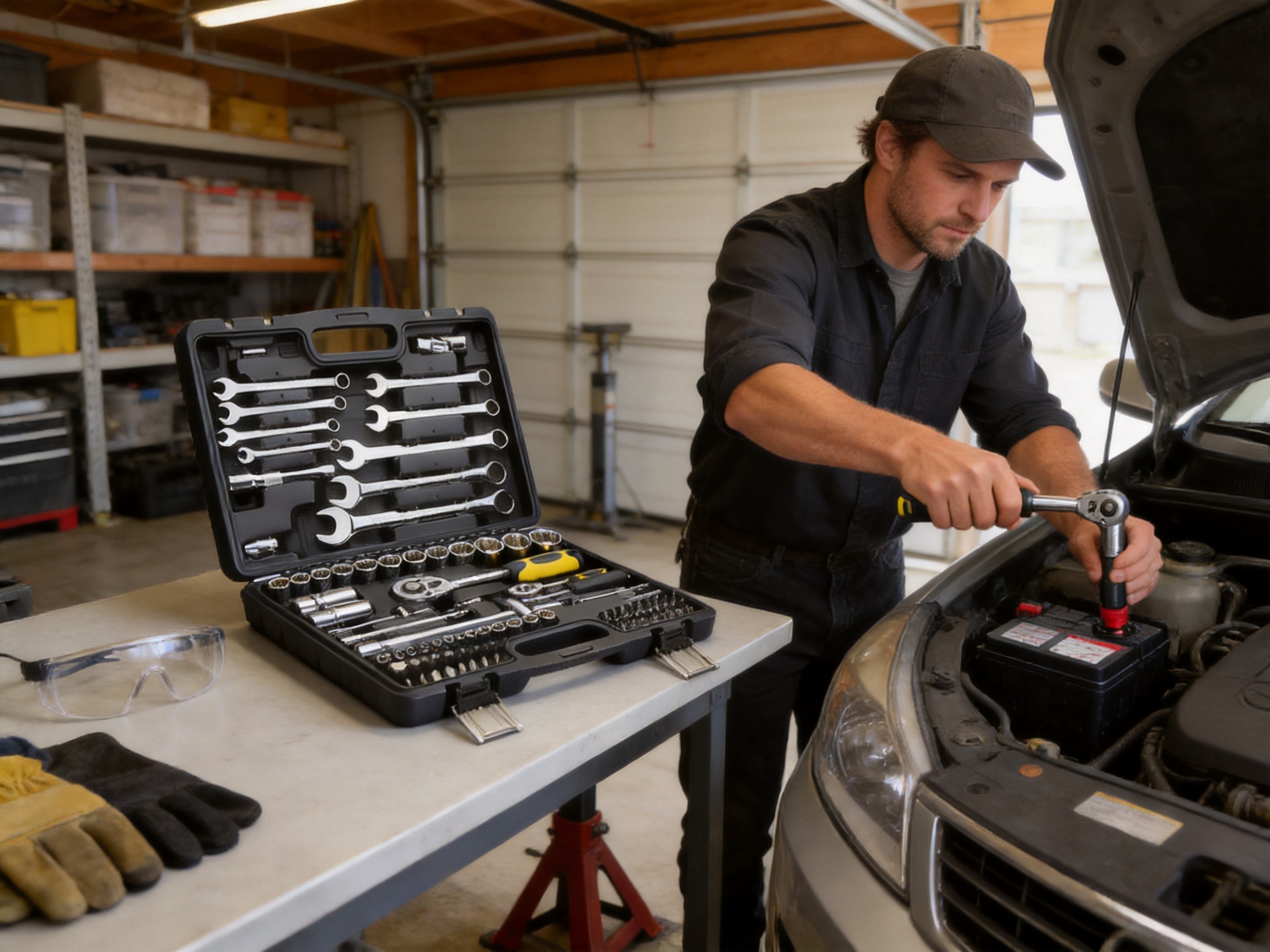
Maintaining a vehicle does not always require a large professional workshop or an extensive collection of separate tools. Many routine repair, adjustment, and service tasks can be completed efficiently when the right combination of sockets, wrenches, adapters, driver bits, extension bars, and handles is available in one organized set. The 82-piece automobile repair service set is designed to provide that combination for home mechanics, vehicle owners, maintenance technicians, mobile service providers, and small repair workshops.
Identified as model LZ000XM000082, this service set brings together commonly used tools for automotive maintenance and general mechanical work. Its range includes 1/2-inch and 1/4-inch socket accessories, universal joints, dual-purpose wrenches, connecting rods, sliding tools, conversion joints, spark plug sockets, screwdriver bits, quick-release wrenches, and a revolving handle. Rather than requiring users to purchase every tool individually, the set groups essential components into one practical system.
The main value of this product is versatility. Automotive service frequently involves fasteners of different sizes, positions, depths, and shapes. A single fixed wrench may work for one task but become unsuitable when access is restricted or a different drive size is required. With multiple socket sizes, extensions, adapters, and driver options, this set allows users to change working configurations quickly and approach a broader range of fasteners with fewer interruptions.
The set is suitable for household vehicle maintenance, emergency roadside preparation, workshop servicing, equipment adjustment, furniture assembly, machinery repair, and other applications involving metric fasteners. It is especially useful for users who want a compact and practical selection of tools without purchasing a full industrial tool cabinet.
Product Overview
The 82-piece automobile repair service set is organized around two primary drive systems: 1/2-inch and 1/4-inch. These drive sizes cover many common automotive applications. The larger 1/2-inch system is appropriate for stronger fastening work and larger sockets, while the 1/4-inch system is useful for smaller fasteners and tighter working spaces.
The set includes a broad metric socket selection. The 1/2-inch series contains 14, 15, 16, 17, 18, 19, 20, 21, 22, 24, 27, 30, and 32 millimeter sockets. The 1/4-inch series contains 4, 4.5, 5, 5.5, 6, 7, 8, 9, 10, 11, 12, 13, and 14 millimeter sockets. This range enables users to select a closer fit for the fastener instead of relying on an approximate size.
In addition to standard sockets, the set contains 16 millimeter and 21 millimeter spark plug sockets, also referred to as special or spark plug sleeves. These components are important for removing and installing spark plugs, where the socket must fit the plug hex securely while also supporting careful handling during removal and installation.
The tool configuration also includes dual-purpose wrenches in 8, 10, 11, 12, 13, 14, 17, 19, and 22 millimeter sizes. These wrenches provide a convenient alternative when a socket cannot be positioned easily or when a fastener is located in a space where an open-ended or combination-style approach is more practical.
For extended reach and improved access, the set includes connecting rods measuring 3 inches, 5 inches, 6 inches, and 10 inches. These extensions can be paired with the appropriate drive tools to reach recessed fasteners. A slide head, sliding rod, elastic rod, revolving handle, and quick-release wrenches further expand the ways the set can be configured.
The bit selection adds another layer of flexibility. It includes Phillips cross bits in PZ3 and PZ4, Phillips sizes number 1, number 2, and number 3, slotted bits from 4 to 12 millimeters, star-shaped bits from T8 to T55, and hexagonal bits from 3 to 14 millimeters. This combination supports many screw and fastener profiles found in vehicles, household equipment, machinery, cabinets, fixtures, and general maintenance work.
Complete Component Coverage
A repair set is only as useful as the coverage provided by its components. The 82-piece configuration is designed to reduce common gaps that occur when users assemble tools one item at a time. A basic wrench collection may lack deep access. A socket set may not contain enough driver bits. A small household kit may not include larger automotive sizes. This product addresses those limitations by combining several tool categories in one system.
| Tool Category | Included Range or Components | Typical Application |
|---|---|---|
| 1/2-inch sockets | 14 to 32 millimeters, with selected intermediate sizes | Automotive fasteners, chassis components, larger bolts, and general mechanical servicing |
| 1/4-inch sockets | 4 to 14 millimeters | Small fasteners, interior components, light assemblies, and confined spaces |
| Dual-purpose wrenches | 8, 10, 11, 12, 13, 14, 17, 19, and 22 millimeters | Fasteners requiring direct wrench access or quick manual adjustment |
| Connecting rods | 3-inch, 5-inch, 6-inch, and 10-inch lengths | Extended reach for recessed or obstructed fasteners |
| Spark plug sockets | 16 millimeters and 21 millimeters | Removal and installation of compatible spark plugs |
| Driver bits | Phillips, Pozidriv, slotted, star, and hexagonal profiles | Screws and specialty fasteners in automotive and household applications |
| Adapters and joints | Universal joints and conversion joints | Angle changes, drive conversion, and improved access |
| Handles and release tools | Sliding rod, elastic rod, revolving handle, and quick-release wrenches | Controlled turning, faster tool changes, and adaptable operation |
This coverage is particularly valuable for users who want one set for multiple tasks. A vehicle owner may use the smaller sockets for battery terminals, interior fittings, and trim-related fasteners, while the larger sockets can be used for wheel-related or engine-bay service tasks where the size is appropriate. A workshop technician may use the same set for vehicle repairs, equipment adjustments, and general maintenance.
The inclusion of several drive accessories also helps prevent unnecessary tool changes. For example, a user can combine a socket with an extension bar for depth, use a universal joint to approach an angled fastener, or switch to a bit holder configuration for a screw head. This modular arrangement makes the set more adaptable than a collection of isolated fixed tools.
Designed for Automotive Service
Automotive repair involves a variety of working conditions. Fasteners may be exposed to dirt, oil, vibration, heat, corrosion, or previous over-tightening. Some are positioned in open areas, while others are located behind brackets, beneath components, or inside narrow engine-bay spaces. A useful service kit must therefore support more than simple turning force. It must also provide access, compatibility, control, and size selection.
The 1/2-inch socket system offers a practical foundation for larger automotive work. Its size range extends from 14 millimeters through 32 millimeters, covering many common metric fasteners. The inclusion of sizes such as 17, 19, 21, 22, 24, 27, 30, and 32 millimeters gives users meaningful coverage for larger bolts and nuts that are often beyond the range of small household sets.
The 1/4-inch system complements the larger drive set by addressing smaller fasteners. Small metric sizes are frequently used in interior panels, sensor brackets, electrical supports, light assemblies, covers, and other vehicle components. The compact drive format is also easier to position where a larger ratchet or handle would be inconvenient.
Universal joints and conversion joints are useful when direct alignment is difficult. A socket normally works best when the drive tool and fastener are aligned. However, automotive structures often restrict a straight approach. A joint can provide additional flexibility, allowing the user to work around an obstruction while maintaining a connection between the handle and socket.
The extension rods provide reach without forcing the user to use an improvised solution. The four listed lengths allow users to select a suitable extension rather than combining excessive numbers of short pieces. A shorter extension can improve control, while a longer extension can reach fasteners located deeper inside an assembly.
Spark plug sockets add specific automotive value. Spark plug service requires a correctly sized socket and careful handling to avoid damaging the plug hex or surrounding components. The 16 millimeter and 21 millimeter options address commonly encountered plug dimensions, although users should always confirm the required size for the vehicle before beginning service.
Advantages Compared with Incomplete Tool Collections
Many low-cost tool collections appear attractive because they contain a small number of frequently used items. However, incomplete sets can create difficulties when a repair requires a less common size, a different drive system, or a special bit profile. The user may have to stop work, purchase another tool, or use an unsuitable substitute. The 82-piece configuration offers a more balanced selection for users who want broader readiness from one purchase.
One advantage is size continuity. The set includes small sockets beginning at 4 millimeters and larger sockets reaching 32 millimeters. Although no single kit can cover every possible automotive fastener, this range is more useful than a narrow group of only the most common sizes. Size continuity also helps reduce the temptation to force an almost-correct socket onto a fastener.
A second advantage is drive-system flexibility. A 1/4-inch drive is practical for smaller fasteners and restricted spaces, while a 1/2-inch drive provides a stronger platform for larger sockets. Users do not have to rely on one drive size for every task. This division can improve handling and reduce unnecessary strain on small tools during larger jobs.
A third advantage is access control. Extension bars, universal joints, sliding rods, and revolving handles support different working angles and reach requirements. Compared with a simple wrench-only collection, this configuration gives users more options when a component blocks a direct path to the fastener.
A fourth advantage is fastener-profile coverage. Phillips, Pozidriv, slotted, star, and hexagonal bits are included. This helps users handle more than standard hexagonal nuts and bolts. Modern vehicles and equipment use several screw profiles, and a kit with only one bit type can become restrictive very quickly.
A fifth advantage is consolidated purchasing. Buying individual tools often results in inconsistent quality, mismatched drive systems, and unnecessary duplication. A coordinated set offers a more consistent working experience. The components are intended to function as one service group, making it easier for users to select a compatible accessory and continue working.
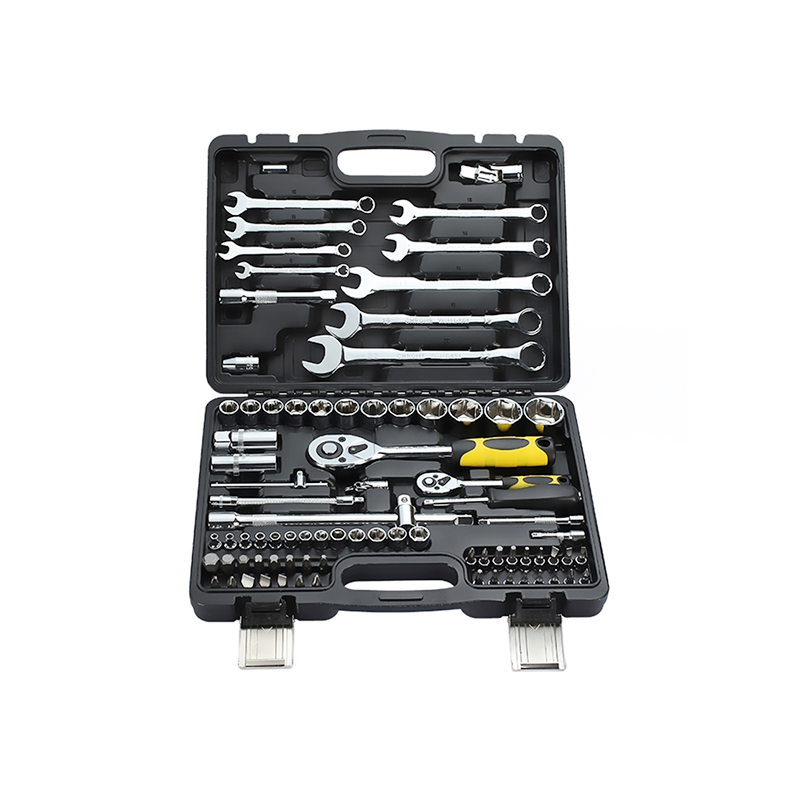
82pc Automobile service home tools
Engineering and Manufacturing Strengths
Lizhan Hardware Co., Ltd. operates as a hardware manufacturer serving fastener and tool-related product categories. Its product portfolio includes home tools, automobile service tools, fasteners, packaging products, and stamping parts. This broader manufacturing background is relevant to the development of an automotive service set because tool production depends on many of the same disciplines used in precision hardware manufacturing.
Manufacturing a multi-piece service set requires more than producing individual metal components. Each socket, wrench, bit, rod, adapter, and joint must be designed to work within a compatible system. Dimensional consistency is essential. If the drive interface is not controlled accurately, an extension may fit loosely, a socket may not engage correctly, or a joint may not operate smoothly.
A capable hardware manufacturer must therefore manage several stages, including material preparation, forming, machining, heat treatment where applicable, surface processing, dimensional inspection, assembly, and packaging. The precise production route may vary according to the component, but the overall objective remains the same: produce reliable, compatible, and repeatable parts in commercial quantities.
Material Preparation and Component Forming
Socket and wrench production begins with suitable metal stock selected for the intended application. The material must be capable of tolerating repeated contact with fasteners and the turning forces generated during normal use. Component forming may involve forging, pressing, machining, or a combination of processes depending on the part design and required geometry.
Forging and forming processes can help create strong basic shapes with efficient material distribution. Machining is then used to refine drive openings, socket interiors, wrench openings, bit profiles, and other functional surfaces. For a set containing multiple sizes, repeatability is especially important because each size must meet the same design principles while maintaining its own specified dimensions.
Small components such as adapters and joints require careful attention to fit. They contain interfaces that must connect correctly to sockets, handles, and extension rods. Poorly controlled interfaces can create looseness, difficult tool changes, or uneven load transfer. A structured manufacturing process helps reduce these problems.
Machining and Dimensional Control
Machining accuracy has a direct effect on the usefulness of a service set. A socket must engage the fastener at the intended contact surfaces. A bit must match the screw profile closely enough to reduce slipping during normal operation. A drive opening must accept the corresponding square drive without excessive play.
Dimensional control may be supported by production drawings, gauges, sampling procedures, and inspection records. Components can be checked for internal dimensions, external dimensions, length, profile, alignment, and interface compatibility. For a multi-piece product, quality control must address both individual parts and the complete set as a system.
The broad size range in this product makes process consistency especially important. The 4 millimeter 1/4-inch socket and the 32 millimeter 1/2-inch socket are very different in scale, but both should follow a controlled production standard. Likewise, the 3-inch and 10-inch connecting rods need to provide predictable compatibility with their designated drive accessories.
Surface Treatment and Protection
Surface treatment plays several roles in hardware products. It can improve visual consistency, help protect metal surfaces during storage and transportation, and make the tool easier to clean after use. Automotive tools may come into contact with oil, dust, moisture, and workshop contaminants, so a practical surface finish is an important part of product usability.
A suitable finish may also help reduce the effects of handling and storage. Tools are frequently placed in cases, drawers, toolboxes, or service vehicles where they may encounter abrasion. Proper surface processing can support a longer usable appearance and contribute to easier maintenance.
Users should still clean and dry the tools after exposure to moisture or corrosive substances. No surface treatment eliminates the need for reasonable care. Wiping away oil, dirt, and water helps preserve the set and makes it easier to identify damage or wear before the next use.
Assembly, Inspection, and Packaging
The final assembly stage brings the individual parts together into a usable service set. This includes matching components, confirming quantities, organizing the sizes, and checking that the appropriate accessories are included. For an 82-piece set, counting and configuration control are especially important because a missing small adapter can affect the usability of several other components.
Packaging is also a functional consideration. A well-organized package helps users locate sizes quickly and reduces the risk of pieces becoming mixed or lost. It can support inventory checks when the set is used in a workshop or service vehicle. Clear identification of the different socket and bit sizes improves efficiency during work.
Before shipment, finished products may be subject to appearance checks, quantity verification, dimensional sampling, and packaging inspection. These measures help create a consistent result across production batches. For distributors and importers, reliable configuration control is particularly valuable because it reduces discrepancies between product descriptions, purchase orders, and delivered goods.
Benefits for Home Users
Home vehicle owners often need a tool set for maintenance tasks that fall between simple household repairs and professional workshop operations. They may need to replace a battery, remove a cover, adjust a bracket, install accessories, change a component, or perform basic inspection work. Purchasing individual professional tools for each task can be expensive and inconvenient.
The 82-piece set gives home users a broad starting point. The included metric sizes are suitable for many vehicles and general mechanical applications. The selection of bits also makes the set useful beyond automotive work. Homeowners can use appropriate components for furniture hardware, equipment panels, shelving, fixtures, and other projects, provided the tools are used within safe operating limits.
The range of handles and extensions is helpful for users who may not yet have developed a large personal tool collection. Instead of buying a separate extension, adapter, and special driver for every project, the user can select from the components already included. This can make routine maintenance more approachable and reduce delays caused by missing accessories.
At the same time, users should recognize the limits of home service tools. Tasks involving high torque, seized fasteners, suspension components, structural repairs, or safety-critical systems may require professional equipment and training. The set is a versatile maintenance solution, but it should not encourage unsafe repair practices or the use of tools outside their intended purpose.
Benefits for Workshops and Mobile Technicians
Small workshops and mobile technicians often prioritize portability, tool coverage, and fast access. A large toolbox may contain more specialized equipment, but it can also be heavy and difficult to transport. An 82-piece service set can serve as a practical supplemental kit for common jobs or as a mobile backup for service calls.
For mobile work, the combination of 1/4-inch and 1/2-inch systems is valuable because it covers both small and larger fasteners without requiring multiple unrelated kits. Extension rods and universal joints help address varying vehicle layouts. The selection of screwdriver bits also reduces the need to carry a separate driver-bit case for routine tasks.
In a workshop environment, the set can be assigned to a workbench, service cart, training area, or maintenance station. A standardized kit makes it easier to establish consistent tool availability. New technicians and apprentices can learn how to select sockets, extensions, adapters, and bits from a clearly defined group.
Distributors may also find the product suitable for retail, e-commerce, automotive accessory, hardware, and industrial supply channels. Its broad application range makes it relevant to several customer groups rather than only to specialized mechanics. The product can be positioned as a practical combination set for vehicle owners and general maintenance users.
Efficient Use of the Tool System
Correct tool selection improves both performance and safety. Users should begin by identifying the fastener type and measuring or confirming the required size. The closest correct socket should be selected rather than a tool that appears to fit loosely. A properly matched socket reduces slipping and helps protect the fastener edges.
For smaller fasteners, the 1/4-inch system is generally more suitable because it offers a compact working profile. For larger fasteners, the 1/2-inch system provides a more appropriate connection. Users should avoid applying excessive force through a small-drive tool simply because the required socket size is available through an adapter.
Extension rods should be selected according to the access requirement. A short extension can preserve control when the fastener is only slightly recessed. A longer extension can be useful for deep access, but excessive length may increase flex or reduce the user’s ability to maintain alignment. The universal joint should be used to solve an access problem, not as a substitute for correct alignment when a straight connection is available.
The sliding rod and revolving handle can support different operating methods. A sliding handle may be positioned to improve leverage or clearance, while a revolving handle can be useful for faster turning once the fastener has been loosened. Users should apply force smoothly and avoid striking handles or extension components unless the tool is specifically designed for impact use.
Driver bits should be selected according to the screw profile. A Phillips bit should not be forced into a Pozidriv recess, and a slotted bit should match the width of the slot as closely as possible. Star and hexagonal bits should be fully seated before turning. Proper seating reduces the risk of cam-out, profile damage, and injury from sudden tool release.
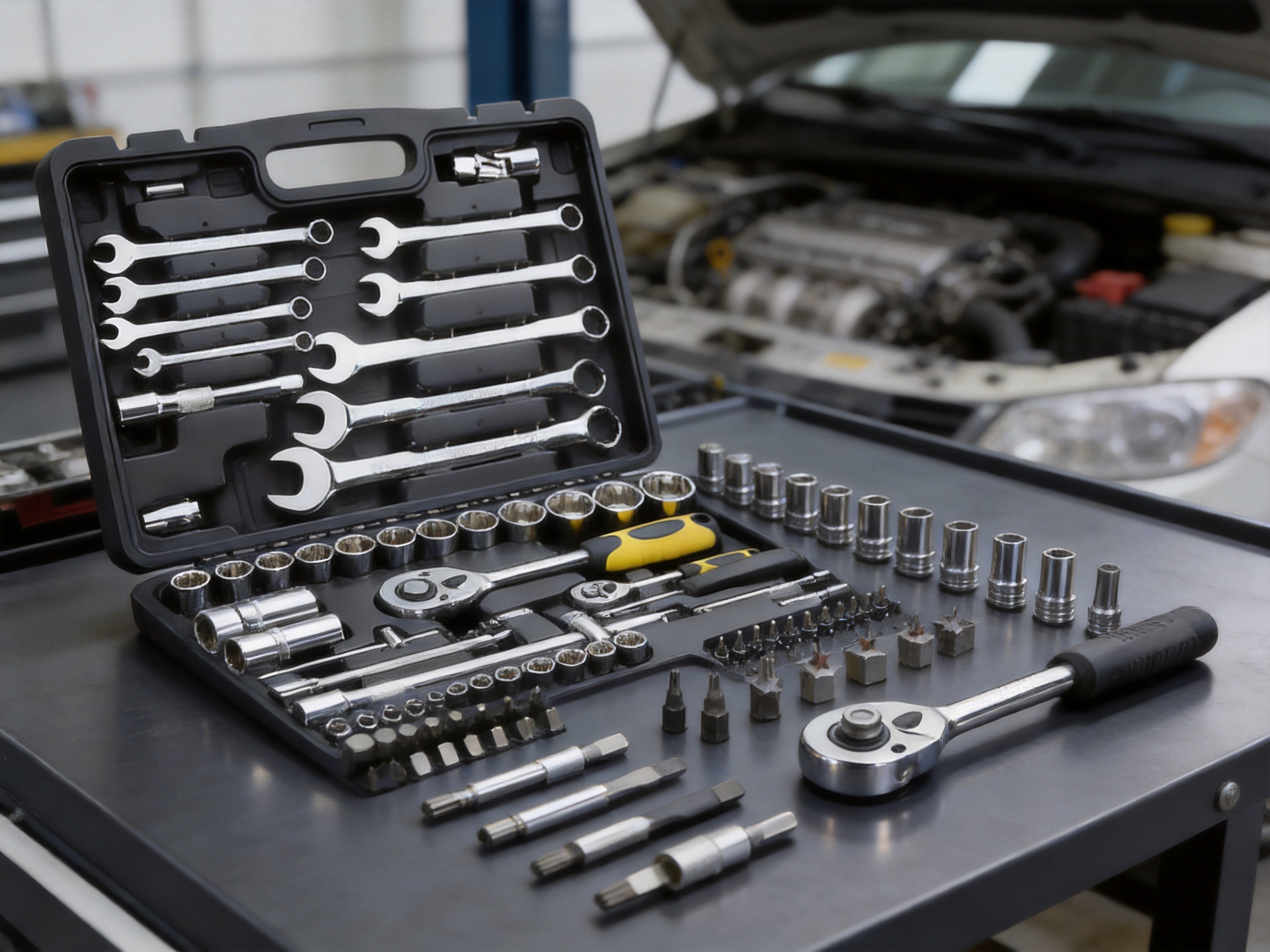
Automotive Applications
Engine-Bay Maintenance
The engine bay contains fasteners in several sizes and positions. Covers, brackets, air intake components, battery supports, sensor mounts, and accessory fittings may require different sockets or driver bits. The two drive systems allow users to choose a compact tool for smaller components and a larger system for more substantial fasteners.
Extensions can help reach fasteners located below hoses, brackets, or other obstructions. However, users should confirm that the extension and socket remain seated on the fastener. Working at an angle can create side loading, so a universal joint should be used carefully and only when necessary.
Battery and Electrical Component Service
Battery supports and related hardware often require metric sockets or wrenches. The smaller socket range and dual-purpose wrenches can be useful for these tasks. Before working around a battery or electrical system, users should follow the vehicle manufacturer’s safety instructions, disconnect power where appropriate, and prevent accidental contact between conductive tools and unintended terminals.
Spark Plug Replacement
The included 16 millimeter and 21 millimeter spark plug sockets provide dedicated options for compatible spark plug sizes. A user should verify the correct socket size and replacement procedure for the specific vehicle. The work area should be clean before removing a spark plug so that debris does not fall into the cylinder area.
When installing a spark plug, the socket should be used to guide the plug into position without forcing it. The thread should start smoothly by hand or with a suitable extension before final tightening according to the vehicle manufacturer’s specification. Over-tightening can damage threads or components, so a torque-controlled method may be appropriate for critical applications.
Interior and Body Hardware
Vehicle interiors and body panels may use small metric fasteners as well as Phillips, Pozidriv, slotted, star, and hexagonal screws. The bit selection in this service set provides useful coverage for these profiles. The compact 1/4-inch system can help in confined spaces such as dashboards, consoles, door panels, and trim assemblies.
General Mechanical Maintenance
The set is not limited to vehicles. It may also be used for motorcycles, bicycles, machinery covers, workshop equipment, agricultural accessories, furniture hardware, and household repair projects. The user should confirm fastener size and tool suitability in each application. Avoiding misuse helps preserve both the tool and the workpiece.
Quality, Consistency, and Supplier Capability
When purchasing a multi-piece hardware product, customers evaluate more than the number printed on the package. They also consider manufacturing consistency, product configuration, communication, order fulfillment, packaging, and supplier reliability. These factors are important for individual buyers, importers, wholesalers, and distributors alike.
Lizhan Hardware Co., Ltd. presents itself as a China-based hardware manufacturer with a factory address in Haiyan, Jiaxing City, Zhejiang, and a warehouse location in Chonburi, Thailand. A manufacturing location in China combined with an overseas warehouse can support supply coordination for different customer markets. The practical value of such an arrangement depends on inventory planning, order quantities, shipping arrangements, and customer requirements.
The company’s involvement in fasteners, stamping parts, packaging products, and home tools indicates experience across several hardware-related production categories. This product diversity can support integrated product development, packaging coordination, and customization discussions. Customers seeking private-label packaging, product bundling, or related hardware sourcing may benefit from communicating their requirements directly to the supplier.
For commercial buyers, it is advisable to confirm the exact set composition, material specifications, surface finish, packaging method, carton quantity, sample availability, production lead time, and inspection procedure before placing an order. Written confirmation is especially important for a product with a defined piece count and many different component types.
Purchasing Considerations for Distributors
Distributors should evaluate whether the product matches the expectations of their target market. A home-tool retailer may emphasize versatility and convenience, while an automotive supplier may focus on the socket range, spark plug accessories, and drive-system compatibility. Industrial buyers may require additional information about materials, testing, packaging, and supply capacity.
Product descriptions should clearly state the 82-piece configuration and list the included sizes. Clear information helps customers understand the value of the set and reduces confusion at the point of sale. It is also useful to explain that the set is intended for general automotive service and home maintenance, while specialized heavy-duty or impact applications may require dedicated tools.
Packaging design should protect the components during transport and make inventory checking straightforward. Small bits and adapters should be secured so they do not move excessively inside the package. Socket sizes should be legible, and the overall arrangement should allow customers to identify the contents without removing every piece.
For larger orders, distributors may ask about private labeling, color options, packaging language, barcode requirements, carton markings, and quality documentation. These requirements should be discussed before production begins. A supplier with experience in hardware and packaging may be able to coordinate multiple aspects of the finished product, subject to project specifications.
Maintenance and Storage Recommendations
Tools should be wiped clean after use, particularly when exposed to engine oil, grease, coolant, dust, or moisture. A clean surface makes it easier to inspect for cracks, deformation, corrosion, or excessive wear. Any damaged component should be removed from service rather than returned to the set without evaluation.
The set should be stored in a dry location away from standing water and corrosive chemicals. If the tools are kept in a vehicle, the storage case or container should be secured to prevent continuous movement. Repeated impact during transportation can damage surfaces, packaging, or small accessories.
Users should keep the components organized according to size and drive type. Returning each piece to its assigned position helps prevent loss and speeds up the next repair. It also makes it easier to identify whether the set is complete before beginning a job.
Lubrication may be appropriate for moving joints or release mechanisms according to the manufacturer’s recommendations. Excessive lubricant should be removed from gripping surfaces and drive interfaces because it can reduce control. A maintenance routine does not need to be complicated; regular cleaning, inspection, and correct storage provide meaningful protection.
Safety Practices
Safety begins with using the correct tool for the task. Do not use sockets or bits that are cracked, rounded, excessively worn, or visibly deformed. Do not use a hand-tool set as an impact-tool system unless the individual components are specifically rated for impact operation.
Wear suitable eye protection during vehicle repair. Loose dirt, rust, and metal particles may fall when a fastener is turned. Gloves can help protect hands from sharp edges and contaminants, but they should not reduce the user’s ability to control the tool.
Before working beneath a vehicle, use appropriate lifting equipment and secure supports. Never rely only on a vehicle jack. For electrical, fuel, braking, steering, suspension, or airbag-related work, follow the vehicle manufacturer’s procedures or consult a trained technician.
Apply force in a controlled direction and maintain stable footing. Keep hands clear of pinch points, and avoid placing the face or body directly behind a loaded tool. If a fastener is seized, use an approved penetrating product or professional method rather than uncontrolled force that could damage the tool or cause an injury.
Why a Balanced Set Matters
The usefulness of a service set depends on how well its parts work together. A collection made up only of sockets may lack reach. A collection made only of wrenches may lack access. A collection with many bits but no suitable handles may not be practical. The 82-piece set combines the main tool categories required for a broad range of maintenance situations.
Its balance between 1/4-inch and 1/2-inch components is one of its strongest practical features. The smaller system supports precision and access, while the larger system supports larger fasteners and more demanding general service. The connecting rods, universal joint, conversion joint, and multiple handles add flexibility without requiring a separate accessory collection.
The metric socket coverage also reflects the needs of many modern vehicles and mechanical products. Including both common and less frequently selected sizes can reduce the number of situations in which a user must stop work to find another tool. The addition of specialized spark plug sockets and multiple driver-bit profiles further increases the range of possible applications.
Compared with buying a few separate tools based only on immediate needs, a complete service set may provide better long-term readiness. It can serve as a foundation for a home toolbox, a backup for a professional workshop, or a portable kit for maintenance work. As the user’s experience grows, additional specialized tools can be added around this core set.

Frequently Asked Questions
What is included in the 82-piece automobile service set?
The set includes projectile or standard sleeves, universal joints for the 1/2-inch and 1/4-inch systems, dual-purpose metric wrenches, connecting rods in four lengths, a slide head, sliding rod, elastic rod, conversion joint, 1/2-inch sockets from 14 to 32 millimeters, 16 millimeter and 21 millimeter spark plug sockets, 1/4-inch sockets from 4 to 14 millimeters, multiple screwdriver-bit profiles, quick-release wrenches, and a revolving handle.
Is the set suitable for home vehicle maintenance?
Yes. It is designed for general automobile service and home-tool use. It can support many routine tasks involving metric fasteners and common screw profiles. Users should consult the vehicle manufacturer’s instructions and seek professional assistance for safety-critical or highly specialized repairs.
What drive sizes are provided?
The product includes both 1/2-inch and 1/4-inch drive systems. The 1/2-inch system is intended for larger sockets and more substantial automotive fasteners, while the 1/4-inch system is useful for smaller fasteners and confined spaces.
What socket sizes are available?
The 1/2-inch socket range includes 14, 15, 16, 17, 18, 19, 20, 21, 22, 24, 27, 30, and 32 millimeters. The 1/4-inch range includes 4, 4.5, 5, 5.5, 6, 7, 8, 9, 10, 11, 12, 13, and 14 millimeters.
Does the set include spark plug sockets?
Yes. It includes 16 millimeter and 21 millimeter spark plug sockets. The correct size should be confirmed against the vehicle before use, because spark plug dimensions can vary between engines and models.
What types of screwdriver bits are included?
The bit selection includes PZ3 and PZ4 Pozidriv profiles, Phillips number 1, number 2, and number 3, slotted bits from 4 to 12 millimeters, star-shaped bits from T8 through T55, and hexagonal bits from 3 to 14 millimeters.
Why are extension rods useful in automotive repair?
Extension rods provide additional reach when a fastener is recessed or blocked by surrounding components. The set includes 3-inch, 5-inch, 6-inch, and 10-inch connecting rods, allowing users to select a length appropriate for the working space.
When should a universal joint be used?
A universal joint can help when a straight line from the handle to the fastener is obstructed. It should be used carefully and with good alignment. If a direct connection is possible, that configuration is generally preferable for control and efficient force transfer.
Can the tools be used for impact applications?
The available product information identifies the set as an automobile repair and home-tool set but does not specify impact ratings. Unless the manufacturer confirms that a component is impact-rated, users should operate the tools as hand tools and avoid impact guns, hammers, or other impact methods.
Is the set useful outside automotive repair?
Yes. The metric sockets, wrenches, extensions, adapters, and driver bits can also be useful for machinery maintenance, equipment adjustment, furniture assembly, household repairs, motorcycles, bicycles, and other mechanical tasks. Suitability depends on the fastener, working load, and application.
What should commercial buyers confirm before ordering?
Commercial buyers should confirm the exact component list, piece count, materials, surface treatment, packaging, labeling, carton quantity, sample process, inspection requirements, delivery schedule, and any private-label or customization needs. These details should be documented before production.
Where is the manufacturer located?
The manufacturer identifies a factory address in Haiyan, Jiaxing City, Zhejiang, China, and a warehouse address in Chonburi, Thailand. Buyers should contact the supplier directly for current production, inventory, and shipping arrangements.
Conclusion
The 82-piece automobile repair service set is a versatile solution for users who want broad coverage in one coordinated tool collection. Its combination of 1/2-inch and 1/4-inch drive systems, metric sockets, dual-purpose wrenches, extension rods, joints, spark plug sockets, specialized bits, and multiple handles makes it suitable for many routine automotive and household maintenance tasks.
Its advantages over incomplete tool collections include wider size coverage, improved access options, multiple fastener profiles, convenient drive compatibility, and reduced dependence on separate purchases. The set is practical for home vehicle owners, small workshops, mobile technicians, maintenance teams, and distributors seeking a multi-application hardware product.
The manufacturing strength behind such a product depends on accurate forming, controlled machining, compatible interfaces, surface treatment, component inspection, configuration control, and secure packaging. Lizhan Hardware Co., Ltd.’s broader involvement in hardware, fasteners, stamping parts, packaging products, and home tools provides a relevant manufacturing foundation for this type of product.
For best results, users should select the correct size, maintain proper alignment, avoid misuse, clean the tools after service, and follow appropriate vehicle safety procedures. Buyers seeking commercial quantities should confirm specifications and supply conditions directly with the manufacturer. Used correctly and maintained responsibly, this service set can provide a dependable foundation for everyday automobile repair and general mechanical work.
References
1. Product specification sheet for the 82-Piece Automobile Repair Service Set, model LZ000XM000082.
2. General principles of hand-tool selection, socket drive compatibility, and fastener engagement.
3. Automotive service guidance concerning spark plug removal, installation, and fastener safety.
4. Industrial hardware manufacturing practices for forming, machining, inspection, surface treatment, and packaging.
5. General workshop safety recommendations for vehicle maintenance and mechanical repair.
6. Metric fastener sizing and common automotive maintenance applications.