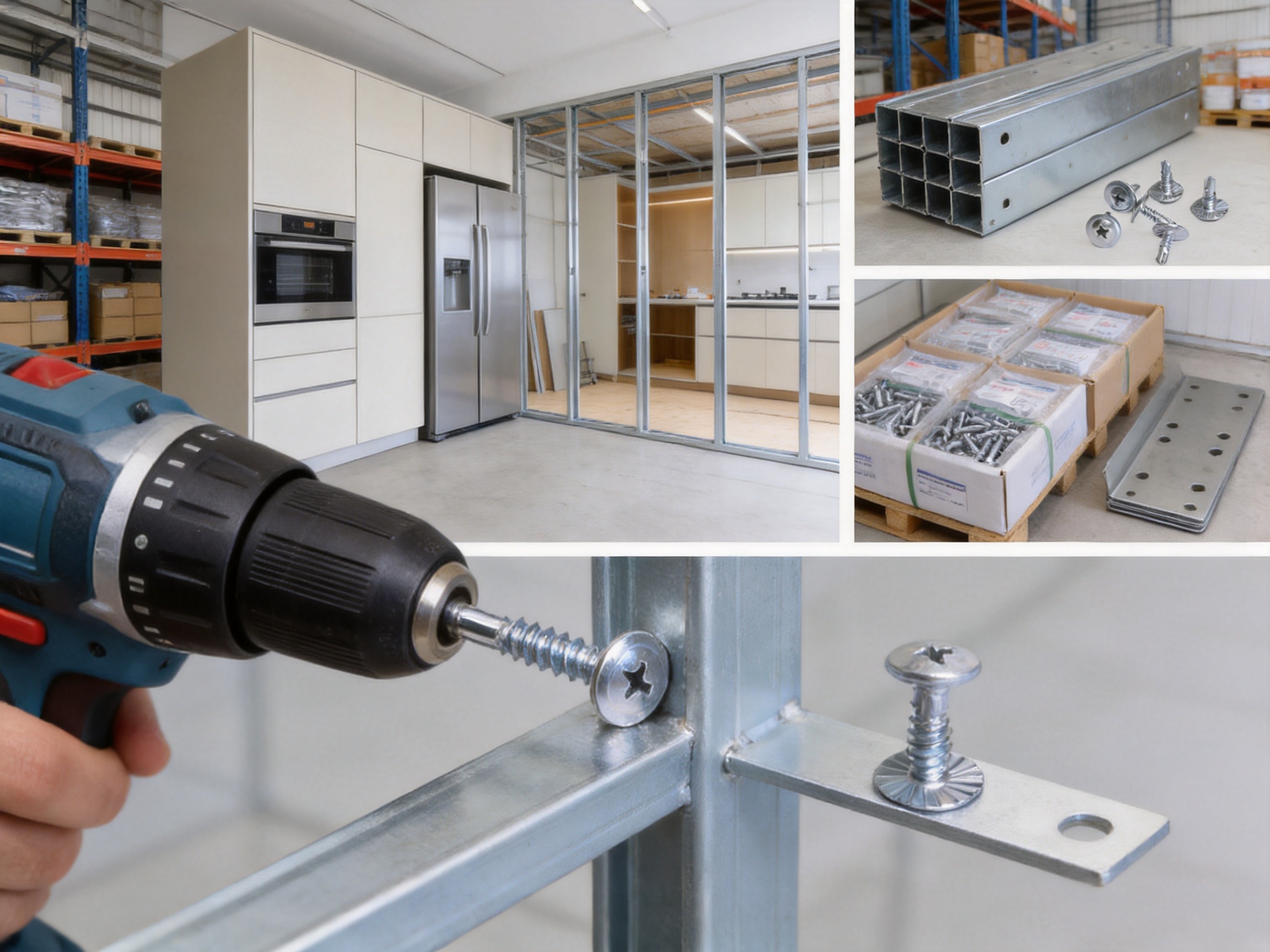
In modern construction, interior installation, furniture production, appliance assembly, and light engineering, the choice of fastener can have a direct effect on productivity, appearance, service life, and total installation cost. A screw that drills efficiently, forms a reliable thread, seats neatly, and resists corrosion can simplify an entire assembly process. The Phillips drive wafer head self drilling screw with a zinc-plated surface is designed to meet these practical requirements in one compact fastening solution.
This product combines a self-drilling point, a sharp forming thread, a low-profile wafer head, and a recessed Phillips drive. The integrated drilling point allows the screw to penetrate many thin metal sections without a separate pilot hole. Once the point has entered the base material, the thread engages and creates a secure mechanical connection. The wafer head provides a broad bearing surface while maintaining a relatively low profile, making the screw suitable for applications where a neat appearance and controlled head height are important.
Manufactured from C1022A carbon steel and available in multiple diameters, lengths, thread configurations, recess styles, head forms, standards, and surface treatments, the product can be adapted to a wide range of industrial requirements. Zinc plating supplies a bright, familiar finish and improves resistance to ordinary atmospheric corrosion when the screw is correctly matched to the environment.
Lizhan Hardware Co., Ltd. supports this product range through production facilities in Haiyan, Jiaxing, Zhejiang, China, together with warehouse support in Chonburi, Thailand. Its product portfolio includes drilling screws, drywall screws, roofing screws, furniture screws, machine screws, fasteners, stamping parts, and related hardware. This combination of product breadth, manufacturing experience, and regional logistics support is intended to help distributors, contractors, furniture manufacturers, and industrial buyers source consistent fastening products efficiently.
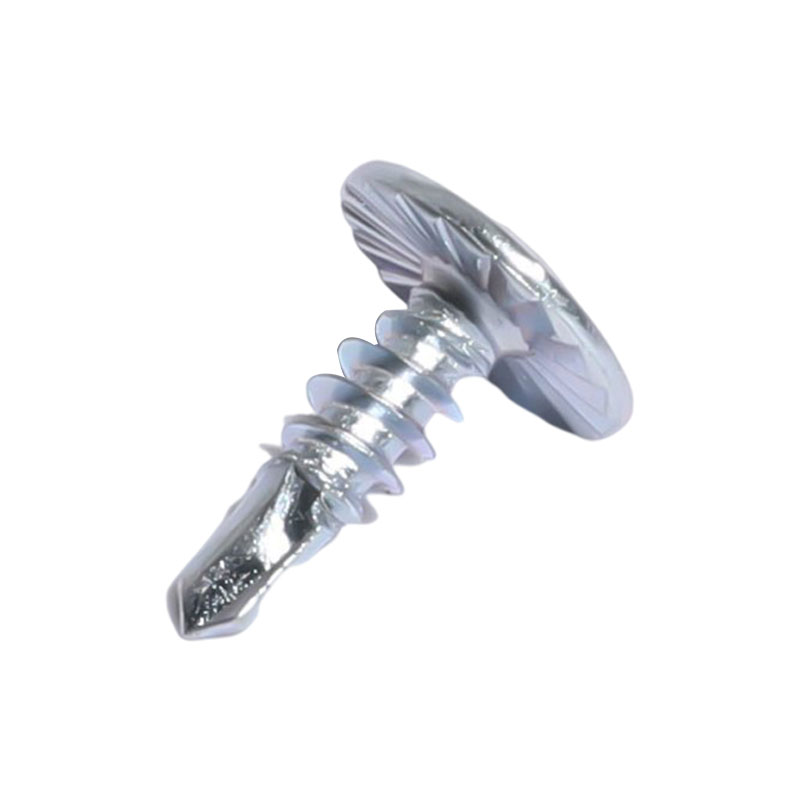
Phillips drive wafer head self drilling screw zinc plated
Understanding the Product
A Phillips drive wafer head self drilling screw is a specialized fastening component developed for applications that require rapid installation into metal, plastic, wood, composite panels, or combinations of these materials. Its name describes the principal features of its construction.
The Phillips drive is the cross-shaped recess formed in the top of the head. It is designed to receive a matching Phillips screwdriver bit. The recess helps transmit rotational force from the tool to the screw while allowing the operator to control installation with commonly available equipment.
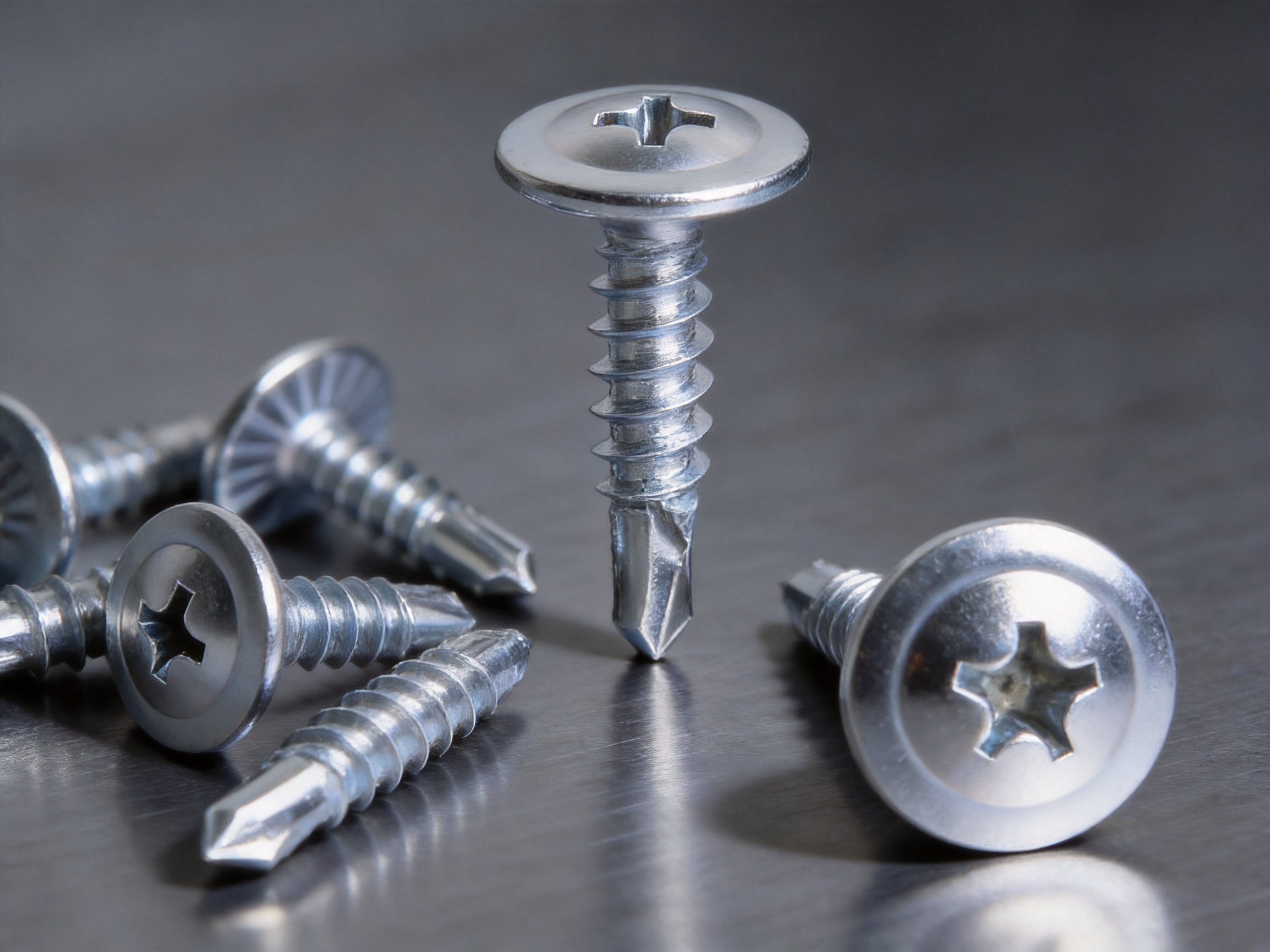
The wafer head is a broad, relatively shallow head with a low overall profile. Compared with a conventional pan head, a wafer head can provide a larger bearing area while reducing visual bulk above the joined materials. This makes it useful in applications where the fastener must hold a thin component securely without creating an excessively high projection.
The self drilling feature comes from the specially formed point. Instead of relying on a separate drill bit to create a pilot hole, the point cuts through suitable sheet materials as the screw rotates. The first thread then engages the newly formed opening and pulls the screw forward. This reduces the number of installation steps and can improve assembly speed.
The zinc-plated surface is produced by applying a zinc coating to the steel substrate. Zinc acts as a protective barrier and can also provide sacrificial protection under many ordinary conditions. The bright metallic appearance is widely accepted in construction and manufacturing environments, and the finish can be selected when a clean, uniform appearance is preferred over black phosphate or other specialized coatings.
Core Product Specifications
The production range includes several screw diameters identified by common number and metric-style values. The available diameter range includes #6-3.5, #8-4.2, #10-4.8, #12-5.5, and #14-6.3. These size options allow buyers to select a suitable balance between drilling capacity, holding strength, head coverage, and material thickness.
| Product Feature | Available Range or Option | Practical Significance |
|---|---|---|
| Drive recess | Phillips, square, or Torx | Supports different tool systems and installation preferences |
| Diameter | #6-3.5, #8-4.2, #10-4.8, #12-5.5, #14-6.3 | Allows selection according to load, material, and assembly scale |
| Head styles | Wafer, bugle, hex washer, flat, pan, pan framing | Provides flexibility for visible finish, bearing area, and clearance requirements |
| Base material | C1022A carbon steel | Offers a practical combination of strength, formability, and production suitability |
| Referenced norms | ASTM, DIN 7504K, DIN 7504P, DIN 7504N | Helps buyers specify recognized dimensional and application categories |
| Surface treatments | Zinc plated, yellow zinc plated, black phosphate, Ruspert, Magni | Supports different corrosion, appearance, and performance requirements |
| Thread types | BSD thread and CSD thread | Permits matching the screw geometry to the intended substrate |
Lengths are selected according to the joining materials, required thread engagement, and the thickness of any components being secured. Because the supplied production range does not specify one fixed length, buyers can discuss the required dimensions with the manufacturer before ordering. A correct length should provide sufficient penetration into the supporting material without creating unnecessary protrusion or interference behind the assembly.
The product can also be supplied with different recesses and head styles within the broader production range. The Phillips wafer head configuration is the subject of this article, but the availability of square and Torx drives demonstrates the manufacturer’s ability to support customers with alternative torque-transfer systems when required.
Material Selection: Why C1022A Carbon Steel Matters
C1022A is a commonly used carbon steel grade for screws and other cold-formed fasteners. It is valued because it provides a useful combination of mechanical performance, forming behavior, machinability, and cost efficiency. For self drilling screws, the material must be suitable for forming the head, recess, thread, and drilling point while retaining adequate hardness and strength after manufacturing and heat treatment.
The steel must be consistent from batch to batch. Variations in chemical composition or material condition can affect head formation, thread accuracy, point geometry, torque performance, and resistance to installation failure. A controlled raw material supply is therefore an important part of reliable screw production.
For many indoor and light-duty construction applications, C1022A provides an appropriate foundation for a cost-effective fastener. It is not selected solely for nominal strength. It is also selected because it can be processed into a precise and repeatable geometry. A screw is only as reliable as the relationship between its material, heat treatment, dimensions, and surface finish.
When the screw is used outdoors, in humid locations, or in contact with chemically aggressive substances, the material and coating must be evaluated together. Zinc plating provides useful general protection, but the final service life depends on exposure conditions, coating thickness, installation damage, contact with dissimilar metals, and maintenance. For more demanding environments, alternative finishes such as Ruspert or Magni may be considered.
Self Drilling Performance and Point Geometry
The drilling point is one of the most important functional areas of the screw. It must initiate a hole smoothly, remove or displace material effectively, and guide the screw into alignment. A poorly formed point can wander across the surface, require excessive pressure, generate unnecessary heat, or fail to penetrate the substrate.
A correctly produced self drilling point reduces the need for pre-drilling in suitable material thicknesses. The installer can position the screw, apply axial pressure, and operate the tool at an appropriate speed. As the point cuts into the material, the thread begins to form or engage behind it. This sequence allows the screw to complete drilling and fastening in a single operation.
Self drilling performance depends on more than the point alone. The relationship between the point length, thread profile, core diameter, material hardness, and coating friction all affect the installation process. The chosen screw must be matched to the material being joined. Thin sheet metal, thicker steel sections, aluminum components, wood panels, and composite boards each present different drilling and holding conditions.
One advantage of this design over ordinary machine screws is the reduction in preparatory work. A machine screw normally requires a preformed threaded hole, a nut, or another threaded component. A standard tapping screw may form its own thread but still require a pilot hole when the substrate is difficult to penetrate. A self drilling screw combines the drilling and fastening functions, which can reduce labor and simplify production lines.
In high-volume assembly, fewer operations can translate into shorter cycle times. The installer does not need to change from a drill bit to a driver bit, locate a separate pilot hole, or manage an additional fastening component. This is especially valuable for repetitive work such as metal framing, cabinet assembly, interior panel installation, and general fabrication.
Wafer Head Design and Installation Appearance
The wafer head is engineered to distribute clamping force over a relatively broad surface. When fastening thin sheet materials or lightweight panels, a narrow head may pull through the surface or create localized distortion. A broader head can improve contact between the fastener and the attached component, provided that the substrate is suitable and the installation torque is controlled.
The low-profile shape is another important advantage. A large projecting head can interfere with moving components, trim, insulation, or adjacent panels. It can also create a visually prominent feature on exposed surfaces. The wafer head offers a more restrained appearance while retaining useful bearing area.
Compared with a flat countersunk head, a wafer head does not require the same degree of countersinking. This can save preparation time and reduce the risk of weakening thin sheet material. Compared with a large hex washer head, the Phillips wafer head may offer a cleaner appearance and easier access in confined spaces where a compact driving tool is preferred.
Head selection should always reflect the application. A wafer head is suitable when surface coverage and low projection are priorities. A hex washer head may be preferred when high installation torque or rapid socket driving is needed. A flat head may be selected when the screw must sit flush with the surface. Lizhan Hardware’s broader head range allows the same sourcing partner to support several assembly designs.
Phillips Drive Advantages and Considerations
The Phillips recess remains widely used because Phillips bits and screwdrivers are readily available in construction, furniture, maintenance, and general manufacturing environments. The cross-shaped geometry makes the screw familiar to installers and suitable for many common cordless power tools.
For light and medium-duty fastening, the Phillips drive can provide efficient installation when the correct bit size is used. The bit should be fully seated in the recess, held in line with the screw axis, and operated at a controlled speed. Excessive pressure at an angle can cause cam-out, which is the tendency of the bit to climb out of the recess under torque.
Proper recess forming is essential. The recess must have consistent depth, clean edges, and accurate alignment with the screw axis. Inconsistent recess geometry can reduce torque transfer and increase the likelihood of bit slippage. Advanced cold forming and inspection processes help manufacturers maintain repeatability across production batches.
One competitive advantage of offering multiple drive options is purchasing flexibility. Some customers standardize on Phillips tools because of existing equipment and labor practices. Others prefer square or Torx drives because they require improved bit engagement for higher torque applications. A manufacturer capable of producing all three options can support different customer standards without requiring a completely separate supply chain.
Zinc Plating and Corrosion Protection
Zinc plating is one of the most widely specified finishes for steel screws. It provides a bright, uniform appearance and a protective coating suitable for many indoor environments and ordinary construction applications. The zinc layer separates the steel substrate from moisture and oxygen, helping slow the corrosion process.
Zinc also has a sacrificial relationship with steel. If a small area of the coating is damaged, zinc can provide a degree of electrochemical protection to the exposed steel under suitable conditions. This does not mean that zinc-plated screws are immune to rust. Exposure severity, coating quality, storage, installation damage, and contact materials all influence actual performance.
For best results, zinc-plated screws should be stored in a dry, clean location and protected from condensation. Packaging should prevent prolonged exposure to moisture and corrosive contaminants. During installation, the operator should avoid unnecessary overdriving, which can damage the coating around the head and create a path for corrosion.
The zinc-plated finish can be compared with other available treatments. Yellow zinc plating offers a different appearance and may be selected for identification or additional coating requirements. Black phosphate is often chosen for interior drywall or dark-colored assemblies. Ruspert and Magni coatings are available when enhanced corrosion resistance, lubricity, or specialized performance is required. The correct finish should be selected according to the environment rather than appearance alone.
When the screw is used with treated wood, coated steel, aluminum, or other dissimilar materials, compatibility should be reviewed. Certain chemical preservatives or moisture conditions may accelerate corrosion. In demanding applications, technical testing or a more resistant coating may be appropriate.
Manufacturing Process and Quality Control
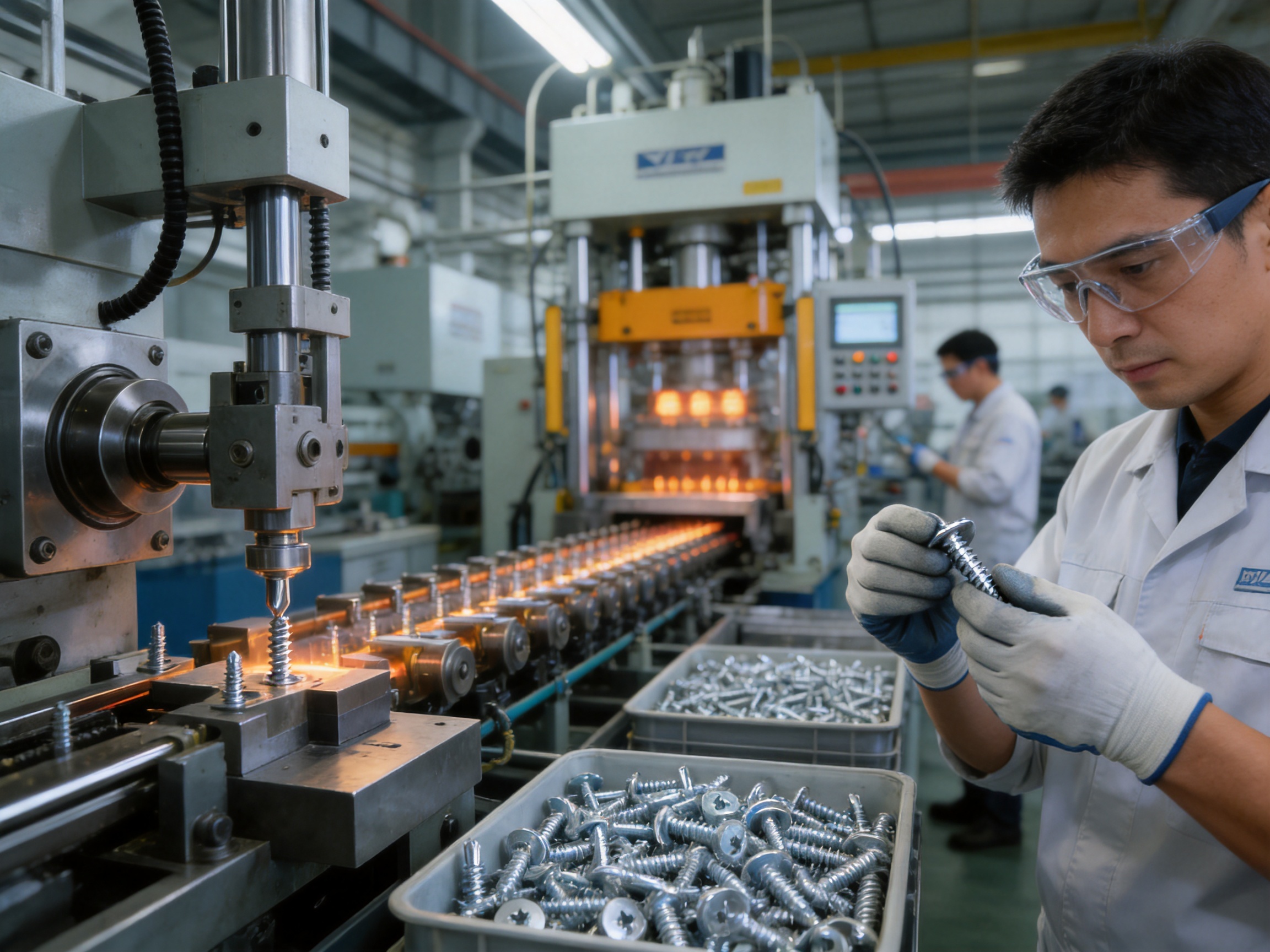
The performance of a self drilling screw depends on the accuracy of a sequence of manufacturing operations. A capable production system must control raw materials, forming, thread rolling, point geometry, heat treatment, surface finishing, sorting, and packaging. Each stage contributes to the final result.
Raw Material Preparation
Production begins with carbon steel wire or suitable steel feedstock conforming to the required material specification. Incoming material is checked for dimensions, surface condition, identification, and consistency. Good raw material preparation reduces variation later in the process and helps prevent defects such as cracks, laps, or incomplete forming.
Cold Heading and Head Formation
The screw blank is commonly formed through cold heading or related cold forming operations. In this process, controlled pressure reshapes the wire into the required head and shank geometry. The wafer head must be formed evenly so that its bearing surface is stable and its outer profile remains consistent.
The Phillips recess is also formed during heading or in a connected forming operation. Accurate die design is required to create the cross-shaped cavity without damaging the head. The relationship between head height, recess depth, recess alignment, and shank centerline must remain within the specified production range.
Thread Rolling
Thread rolling forms the thread by displacing material rather than cutting it away. This process can create a strong, continuous thread profile and a smooth surface finish. For self drilling screws, the thread must be matched to the intended substrate and point design.
BSD and CSD thread options support different drilling and thread-forming requirements. The correct thread geometry can influence installation torque, pull-out resistance, stripping behavior, and the screw’s ability to move through the material efficiently. Thread rolling tools must be maintained carefully because worn tooling can affect pitch, crest shape, root condition, and dimensional consistency.
Point Forming and Drilling Tip Control
The self drilling point is formed to create the cutting profile required by the specification. Point length, angle, symmetry, and transition into the thread all matter. A point that is too short may not complete penetration before the thread engages. A point that is too long may reduce useful thread engagement or create unnecessary material disruption.
Manufacturing controls should verify that the point is centered with the shank and aligned with the head. Misalignment can cause eccentric rotation, poor seating, and uneven stress during installation. Visual inspection, dimensional checks, and functional sampling can help identify point-related problems before shipment.
Heat Treatment
Heat treatment may be used to achieve the hardness and strength balance required for drilling and fastening. The screw must be hard enough for the point to penetrate the selected substrate, yet tough enough to resist brittle fracture and torsional failure. Over-hardening can create brittleness, while insufficient hardness can cause point deformation or thread damage.
Controlled furnace conditions, traceable production batches, and hardness testing are important elements of the process. Heat treatment should be selected with awareness of the screw’s geometry, diameter, drilling function, and final application.
Surface Finishing
After forming and heat treatment, the screws are cleaned and prepared for plating or another surface treatment. Zinc plating requires effective cleaning because oil, scale, and contaminants can interfere with coating adhesion. The finished screws are checked for coverage, color, surface uniformity, and visible defects.
Coating thickness and corrosion performance should be evaluated according to the relevant customer specification or industry requirement. A visually bright surface is useful, but appearance alone cannot confirm coating performance. Proper process control and representative testing provide greater confidence.
Sorting, Inspection, and Packaging
Finished screws are sorted to remove mixed sizes, damaged heads, incomplete threads, bent pieces, or other nonconforming parts. Packaging should identify the product size, finish, quantity, batch information, and any customer-specific requirements. Accurate packaging is particularly important when several visually similar diameters or lengths are supplied to the same customer.
Lizhan Hardware’s product breadth supports an organized approach to fastener manufacturing and distribution. Its range includes several screw categories, head styles, recesses, standards, and surface finishes. This can help customers consolidate purchases and reduce the complexity of managing multiple suppliers.
Advantages Compared with Alternative Fasteners
Compared with Standard Machine Screws
A machine screw is designed to engage with a pre-tapped hole or nut. It can provide excellent repeatability in a prepared assembly, but it normally depends on an existing thread. The Phillips wafer head self drilling screw can create its own opening and engage directly with suitable materials. This makes it more convenient for sheet metal, panel, and mixed-material assemblies where a separate nut or tapped hole is not practical.
Compared with Ordinary Self-Tapping Screws
An ordinary self-tapping screw forms or cuts a thread after entering a pilot hole. The self drilling design adds a drilling point, allowing the screw to perform more of the preparation work itself. This can reduce installation time and eliminate the need for a separate drilling operation in appropriate substrates.
Compared with Rivets
Rivets can provide secure permanent joints, but they generally require access to both sides of the assembly and often require a pre-drilled hole. A screw can frequently be installed from one side and can be removed for maintenance, adjustment, or replacement. The self drilling feature further simplifies the initial installation.
Compared with Nails
Nails are effective in many wood applications but are not ideal for controlled fastening of thin metal sections or assemblies requiring removal. A threaded screw provides improved resistance to withdrawal and allows the installer to regulate clamping force. The wafer head also offers a more controlled bearing surface than a typical nail head.
Compared with Hex Washer Head Screws
Hex washer head screws are often selected for high-speed socket installation and strong torque transfer. However, their larger head shape can be more visible and may require greater clearance. The Phillips wafer head version offers a lower-profile alternative with a broad bearing surface and a familiar drive system. The better choice depends on the installation tool, torque requirement, appearance, and available space.
Applications Across Multiple Industries
The product is suitable for a broad group of applications where a self drilling, low-profile fastening solution is needed. Final selection should be based on substrate thickness, load, environmental exposure, installation equipment, and applicable building or product standards.
Metal Framing and Interior Construction
Light-gauge steel framing often requires fasteners that can penetrate thin metal quickly and hold framing components together. A wafer head can provide useful bearing on the connected section without creating excessive projection. The zinc finish is commonly suitable for dry interior environments, subject to project specifications.
Furniture and Cabinet Assembly
Furniture manufacturers value speed, repeatability, and clean appearance. The low-profile wafer head can help secure brackets, metal fittings, thin panels, and supporting components while maintaining a relatively unobtrusive surface. Phillips tooling is widely available on production floors and in repair environments.
Appliance and Equipment Fabrication
Sheet metal housings, covers, brackets, and internal supports may require compact fasteners that can be installed rapidly. The screw’s drilling point can reduce the need for separate hole preparation, while the broad head can help retain thin components. Designers should verify electrical, vibration, and corrosion requirements for each appliance or equipment application.
Roofing and General Sheet Metal Work
Self drilling screws are widely used in sheet metal work, although the selected head and coating must match the specific roofing or exterior requirement. For exposed outdoor roofing, a specialized coating, sealing washer, or roofing-specific design may be required. The zinc-plated wafer head version is better suited to applications where the product specification calls for a compact metal fastening solution rather than a dedicated weather-sealing roof screw.
Stamping Parts and Light Fabrication
Stamped brackets, clips, plates, and formed metal components often need quick assembly without extensive machining. A self drilling screw can join such parts efficiently when the material thickness and hardness are within the screw’s working range. This is valuable in small-batch fabrication as well as repetitive industrial production.
Maintenance and Repair
Maintenance teams often need versatile fasteners that are easy to identify and install with standard tools. The Phillips drive and zinc-plated appearance are familiar to many technicians. Because the screw can be removed when necessary, it can support service access and component replacement more effectively than a permanent fastening method.
Installation Recommendations
Correct installation is essential for achieving the intended performance of any self drilling screw. The operator should first confirm that the screw diameter, length, finish, head style, and thread type match the material and application.
The driver bit should be the correct Phillips size and should be in good condition. A worn bit can reduce engagement and increase the risk of recess damage. The bit should be aligned with the screw axis, and the tool should be operated at a speed appropriate for the material and screw diameter.
Moderate axial pressure is generally needed while the drilling point is entering the material. Once the screw has penetrated and the thread is engaged, the operator should avoid excessive force. Overdriving can strip the recess, deform the wafer head, damage the zinc coating, or crush the attached material.
The final seating condition should be checked. The head should contact the surface evenly without creating unacceptable distortion. If the screw is installed into thin sheet, the operator should ensure that the head has not pulled through or caused excessive dimpling. If the assembly is exposed to vibration, sample testing may be useful to confirm retention.
For automated or high-volume production, installation torque and tool settings should be monitored. A controlled tool can improve consistency and reduce variation between operators. Production trials should be conducted with the actual substrate, because the ideal settings depend on material hardness, thickness, coating, and joint design.
Purchasing and Specification Guidance
Buyers should provide a complete specification rather than ordering only by a general product name. The required information may include diameter, length, head style, recess, thread type, steel grade, coating, standard, packaging quantity, and intended substrate.
For example, a purchase description might identify a Phillips drive wafer head self drilling screw, C1022A steel, zinc plated, with a specified diameter and length, produced according to the applicable DIN 7504 category or customer drawing. Clear descriptions reduce the risk of receiving a screw with the wrong point, thread, head height, or surface treatment.
Samples can be useful before a large production order. A sample evaluation may include drilling time, installation torque, pull-out resistance, head seating, recess durability, coating appearance, and corrosion testing. These checks allow the buyer to confirm compatibility with the actual assembly process.
Packaging requirements should also be discussed. Industrial users may require bulk cartons, smaller retail boxes, labeled bags, barcode identification, or customer-specific packaging. Consistent labeling is especially important when several close sizes are used on one production line.
Lizhan Hardware can support buyers seeking more than one type of fastener. Its range covers self drilling screws, drywall screws, roofing screws, furniture screws, machine screws, and related hardware. This broader capability can simplify vendor qualification and enable customers to coordinate specifications across several product categories.
Company Manufacturing and Supply Strengths
Lizhan Hardware Co., Ltd. operates from a manufacturing location in Haiyan, Jiaxing, Zhejiang, China, an area associated with fastener production and industrial supply chains. The company also lists a warehouse location in Chonburi, Thailand. A production base and regional warehouse structure can provide practical benefits for international customers, including production coordination, inventory planning, and improved access to Southeast Asian markets.
The company’s stated product categories include new products, home tools, fasteners, packages, and stamping parts. This indicates an approach that extends beyond one screw design. Customers requiring different screw families or associated stamped components may benefit from dealing with a supplier that understands multiple fastening applications.
Its production range includes several recognized norms, including ASTM references and DIN 7504K, DIN 7504P, and DIN 7504N categories. Standards-based production gives buyers a clearer framework for comparing dimensional and functional requirements. However, the exact standard should always be confirmed for the selected head, point, thread, and material combination.
Another strength is finish flexibility. Zinc plated, yellow zinc plated, black phosphate, Ruspert, and Magni options allow the product range to serve different corrosion, appearance, and lubrication requirements. This reduces the need to redesign a fastener when a project moves from an indoor application to a more demanding environment.
Recess and head flexibility also contribute to manufacturing strength. Phillips, square, and Torx drives can be supplied across the production range, while wafer, pan, flat, bugle, hex washer, and pan framing heads address different assembly requirements. Such flexibility is valuable to distributors that need a broad catalog and to OEM buyers that require application-specific configurations.
Manufacturing strength should be evaluated through measurable consistency. Important indicators include dimensional accuracy, thread uniformity, point symmetry, hardness, coating adhesion, corrosion resistance, packaging control, and batch traceability. Buyers may request inspection documentation or product samples according to the importance of the application.
Quality, Reliability, and Competitive Value
The competitive value of this screw comes from the combined effect of its features rather than from one isolated specification. The self drilling point reduces preparation steps. The Phillips recess uses widely available tools. The wafer head provides low-profile bearing. C1022A steel supports practical strength and forming performance. Zinc plating supplies a familiar protective finish. Multiple sizes and standards improve sourcing flexibility.
Competitors may offer individual features, but product value depends on how consistently those features are delivered. A low price does not compensate for inconsistent point geometry, poor recess alignment, mixed packaging, or premature coating failure. For professional buyers, predictable installation and reduced rejection rates can be more important than the initial unit price.
In a production environment, screw quality affects labor as well as material cost. A screw that drills smoothly and seats correctly can reduce stoppages, tool changes, rework, and operator frustration. Consistent packaging can also prevent line-side errors. These indirect savings contribute to the total cost advantage of a well-controlled fastener.
For distributors, range breadth is another competitive factor. A supplier that can offer several sizes, finishes, head types, and drive systems may help distributors maintain a more complete inventory. It can also make private-label, project-specific, or market-specific sourcing easier when packaging and documentation are coordinated.
Environmental and Service-Life Considerations
Fastener selection should reflect the actual environment in which the screw will operate. Zinc-plated carbon steel is generally suitable for dry indoor areas and many ordinary light-duty applications. It may require additional protection or a different coating for continuous outdoor exposure, coastal air, industrial chemicals, high humidity, or contact with treated materials.
Service life is affected by joint design. The screw should be long enough to achieve suitable engagement but not so long that it interferes with hidden components. The joint should distribute load properly, and the attached material should have enough strength to resist pull-through. A larger diameter is not automatically better if it causes excessive distortion or is incompatible with the drilling equipment.
Corrosion prevention also depends on handling. Screws should not be stored directly on damp floors or exposed to condensation. Open packages should be resealed when possible. If the coating is damaged during installation, the damaged area should be considered when evaluating long-term exposure.
Where appearance matters, the bright zinc surface can provide a clean and uniform visual result. Where appearance is less important but corrosion performance is more demanding, a different available finish may be preferable. The supplier can help identify the most appropriate option based on the project conditions.
How to Select the Correct Size
Diameter selection should begin with the required holding capacity and the thickness of the material being joined. Smaller diameters are useful for light components and applications where a compact head is desired. Larger diameters can provide greater thread engagement and increased resistance to pull-out, but they may require higher installation torque and more space.
Length should be selected so that the screw passes through the attached component and develops sufficient engagement in the supporting material. Excessive length can create interference, while insufficient length can reduce holding strength. The drilling point itself should be included when evaluating the effective threaded engagement.
Head coverage is also important. A wafer head may be selected when the attached material is thin and requires a broad contact area. If the material is unusually soft or the load is high, the designer should test whether a larger washer or different head style is needed.
The chosen thread type should match the substrate. BSD and CSD threads may provide different results depending on material thickness and hardness. Buyers should conduct installation trials when moving from one material system to another.
Q&A: Frequently Asked Questions
What is a Phillips drive wafer head self drilling screw?
It is a screw with a cross-shaped Phillips recess, a broad low-profile wafer head, and a drilling point that can penetrate suitable materials without a separate pilot hole. It is commonly used for fastening thin metal, panels, brackets, furniture components, and light fabricated assemblies.
What does zinc plated mean?
Zinc plated means that a layer of zinc has been applied to the steel screw surface. The coating improves appearance and provides protection against ordinary atmospheric corrosion. It is not intended to make the screw permanently corrosion-proof in severe environments.
What material is used for this product?
The listed material grade is C1022A carbon steel. This grade is widely used for fasteners because it supports cold forming, thread production, heat treatment, and practical mechanical performance.
Can the screw drill through steel?
It can drill through suitable steel sheet or light-gauge steel when the material thickness and hardness are compatible with the screw’s point design. The exact working range should be confirmed through product data or application testing before use in thicker or harder steel.
Does installation require a pilot hole?
In suitable substrates, the self drilling point eliminates the need for a separate pilot hole. A pilot hole may still be considered when the material is unusually hard, thick, brittle, or sensitive to distortion, or when the project specification requires one.
What sizes are available?
The listed diameter range includes #6-3.5, #8-4.2, #10-4.8, #12-5.5, and #14-6.3. Lengths should be specified according to the material thickness and required engagement.
What is the difference between a wafer head and a pan head?
A wafer head is generally broader and lower in profile, providing useful bearing with less projection. A pan head is more rounded and may be selected for different clearance or appearance requirements. The best option depends on the joint design and installation conditions.
Why choose a Phillips drive instead of a Torx or square drive?
Phillips drives are compatible with widely available tools and are familiar to many installers. Torx and square drives may provide improved engagement in some higher-torque applications. The preferred recess depends on the customer’s tools, production process, and torque requirements.
Is zinc plating suitable for outdoor use?
It may be suitable for limited or moderate outdoor exposure depending on the coating specification and environmental conditions. Continuous moisture, salt air, chemicals, and severe weather may require Ruspert, Magni, or another specialized finish. The application should be evaluated before final selection.
What standards are associated with the production range?
The listed references include ASTM and DIN 7504K, DIN 7504P, and DIN 7504N. The applicable standard depends on the selected head and point configuration. Buyers should confirm the exact requirement with the supplier.
Can other head and drive styles be supplied?
The broader production range includes Phillips, square, and Torx recesses, as well as bugle, hex washer, flat, pan, wafer, and pan framing heads. Availability should be confirmed for the requested diameter, length, thread, and finish combination.
How should the screw be installed?
Use the correct Phillips bit, align the driver with the screw axis, apply controlled pressure, and avoid excessive speed or torque. The screw should seat firmly without stripping the recess, crushing the attached material, or damaging the coating.
What information should be included in a quotation request?
A quotation request should include diameter, length, head style, recess, thread type, steel grade, surface finish, standard, packaging, quantity, and application material. Providing drawings or samples can further reduce specification errors.
Conclusion
The Phillips drive wafer head self drilling screw zinc plated is a practical and versatile fastener for applications that require quick drilling, reliable thread engagement, controlled head projection, and a clean metallic finish. Its self drilling point can reduce preparation work, while the Phillips recess supports common installation tools. The wafer head offers useful bearing area for thin materials without the visual bulk of some larger head styles.
With C1022A carbon steel, multiple diameter options, BSD and CSD thread choices, recognized standard references, and a broad selection of alternative finishes and configurations, the product can be adapted to many construction, furniture, fabrication, maintenance, and industrial requirements.
Its value is strengthened by the manufacturing and supply capabilities of Lizhan Hardware Co., Ltd. The company’s China production base, Thailand warehouse support, broad fastener portfolio, range of head and drive styles, and surface treatment options provide buyers with a flexible sourcing platform. For customers seeking consistent self drilling screws and related hardware, the product offers a balanced combination of installation efficiency, appearance, adaptability, and cost-conscious performance.
Final product selection should always be based on the actual substrate, load, environment, installation equipment, and applicable specifications. When those factors are reviewed carefully, the zinc-plated Phillips wafer head self drilling screw can provide an efficient and dependable fastening solution for both professional assembly and general construction work.
References
ASTM International. Standards and guidance for steel fasteners and mechanical fastening products.
DIN 7504. Self drilling tapping screws for metal applications, including relevant head and point configurations.
Fastener Quality Act and general industrial practices for fastener identification, inspection, and traceability.
International Organization for Standardization. General principles for corrosion protection, metallic coatings, and fastener testing.
Manufacturer product range information for C1022A self drilling screws, Phillips and alternative recesses, head styles, thread forms, and surface finishes.
General engineering practice for screw selection, installation torque control, joint design, and corrosion-resistant fastening.