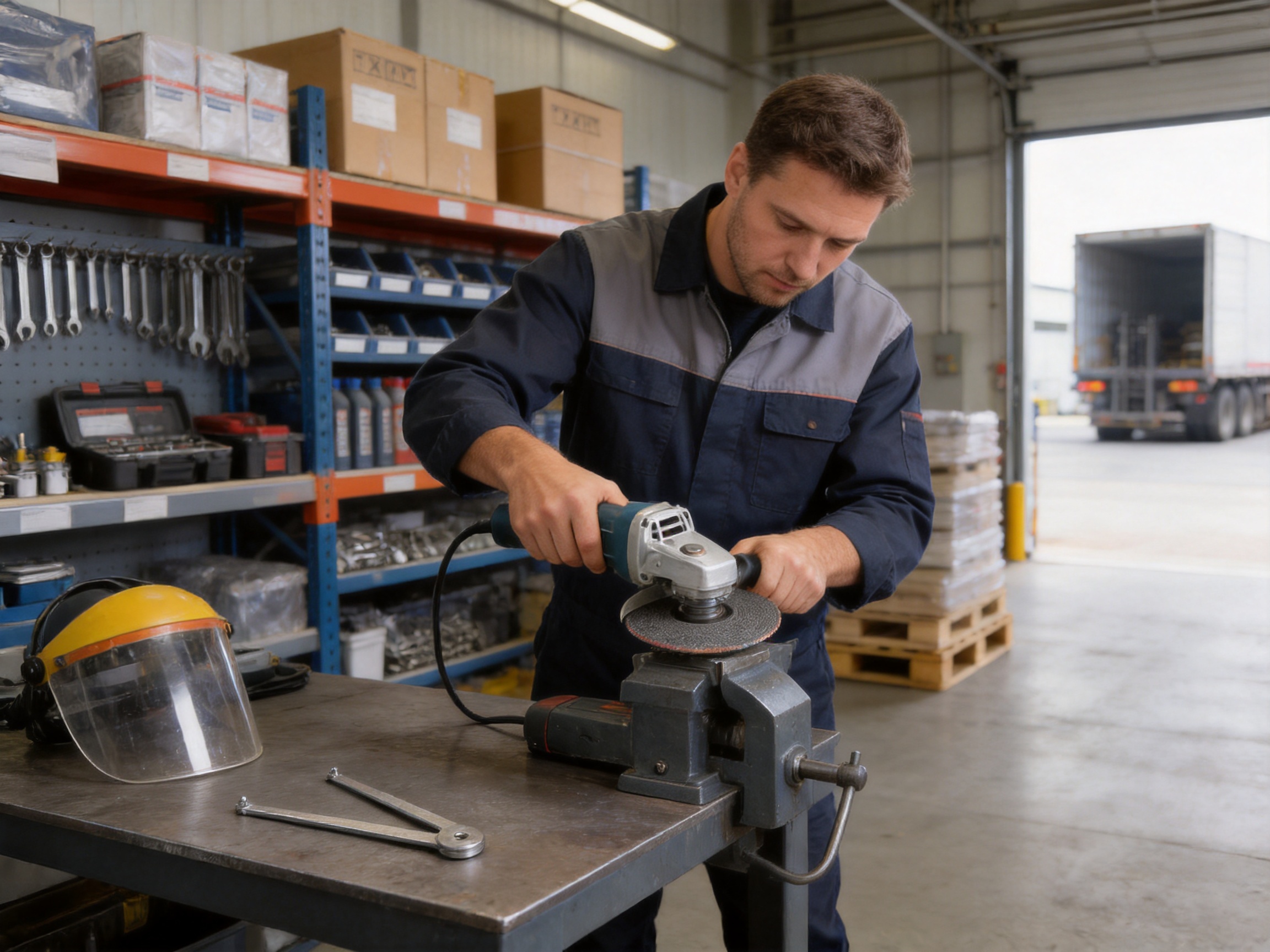
Choosing the correct hand tool for an angle mill or angle grinder can have a direct effect on work efficiency, operating convenience, and maintenance quality. A wrench that is difficult to adjust, poorly matched to the tool, or made from inconsistent material can slow down routine operations and create unnecessary frustration. The multifunction angle mill wrench is designed to provide a practical solution for users who need a compact, adaptable, and reliable tool for angle grinder maintenance and related fastening tasks.
This article examines the product’s design concept, operating value, manufacturing considerations, quality advantages, and possible applications. It also explains how Lizhan Hardware Co., Ltd. supports the product through a manufacturing and supply structure serving customers in China, Thailand, and international markets. The discussion is intended for importers, distributors, hardware retailers, professional users, maintenance teams, and buyers seeking a dependable angle mill wrench supplier.
Understanding the Multifunction Angle Mill Wrench
The multifunction angle mill wrench is a specialized hand tool developed for adjusting and removing components commonly found on angle mills and angle grinders. In ordinary workshop use, operators may need to loosen or tighten a flange nut, change a grinding wheel, replace a cutting disc, or perform routine service on a machine. A dedicated wrench makes these tasks more controlled than using an improvised adjustable wrench, pliers, or another unsuitable tool.
The product belongs to the AT Tool category and is positioned as a compact maintenance accessory. Its basic purpose is simple: provide a suitable interface between the operator and the machine’s fastening components. Its value, however, depends on more than its general shape. The wrench must have a usable grip, correctly positioned working points, adequate strength, suitable dimensional accuracy, and a surface finish that supports repeated handling.
The word “multifunction” indicates that the product is intended to support more than one common adjustment arrangement or fastening application. Depending on the exact production specification, a multifunction angle mill wrench may be designed with multiple pin positions, working points, or compatible openings. This allows one tool to serve several related maintenance requirements and can reduce the need for users to carry multiple separate wrenches.
For professional workshops, tool distributors, and industrial maintenance departments, this compact design can offer practical benefits. It occupies little storage space, is easy to include in a tool kit, and can be supplied with angle mills, grinder accessories, or repair packages. For retailers, it also represents a simple accessory product with broad relevance to construction, fabrication, renovation, metalworking, and home improvement users.
Why a Dedicated Angle Mill Wrench Matters
Angle grinders are used in many demanding environments, including metal fabrication, construction, automotive repair, equipment maintenance, masonry, and home renovation. Their accessories may need to be changed frequently because grinding discs, cutting wheels, polishing pads, and other attachments are consumable or application-specific. A suitable wrench helps users complete these changes with greater consistency.
Using the wrong tool can create several problems. An improvised tool may not engage the fastening points properly. Excessive play can damage the nut or working surface. A poorly fitting tool can slip, causing hand injuries or damage to the machine. Even when no immediate damage occurs, repeated use of an unsuitable tool can increase maintenance time and reduce user confidence.
A dedicated angle mill wrench is designed around the practical dimensions of the relevant fastening components. The working points can be positioned to engage the holes or surfaces more securely, while the handle or body provides leverage appropriate for routine adjustment. The objective is not to replace safe operating procedures or manufacturer instructions, but to make ordinary accessory changes more convenient and controlled.
For commercial users, small time savings can produce meaningful operational benefits. A maintenance worker who changes several discs during a shift benefits from a tool that is easy to locate, easy to position, and quick to use. A retailer can offer the wrench as a useful add-on product. A machine manufacturer or accessory supplier can include it in a service kit or equipment package.
Core Product Advantages
Multi-application convenience
The most visible advantage of the multifunction angle mill wrench is its ability to support several related tasks. Instead of maintaining a separate wrench for every compatible machine or accessory arrangement, users may be able to use one versatile tool for multiple adjustments. This is particularly useful in workshops where different angle mills are used throughout the day.
Multi-application capability also benefits distributors. A product that fits a broader range of common applications may simplify stock management, reduce the number of similar items that must be listed, and make product selection easier for customers. Retail packaging can communicate the main compatible uses while allowing buyers to recognize the wrench as a general maintenance accessory rather than a single-purpose item.
Compact and portable structure
An angle mill wrench is usually small enough to store in a tool case, workbench drawer, machine cabinet, or service vehicle. This compact form makes it convenient for mobile repair teams and construction workers who must transport tools between job sites.
Portability is especially valuable when the wrench is used with equipment that does not have a permanent workshop location. A worker may need to change an accessory on a scaffold, at a construction site, in a fabrication area, or during field service. A compact wrench can travel with the machine or be included with replacement accessories without adding significant weight or storage requirements.
Purpose-designed engagement
A dedicated wrench is designed to engage the intended fastening component in a more suitable manner than a general-purpose tool. Correct engagement helps distribute force across the working area and can reduce the likelihood of slipping during normal adjustment.
The practical quality of this feature depends on dimensional accuracy. If the working points are too large, too small, or incorrectly aligned, the tool may not perform as intended. For this reason, the manufacturing process must pay close attention to forming dimensions, working-point geometry, and final inspection.
Efficient operation
The wrench can help reduce the time required to remove or install grinder accessories. Faster accessory changes do not mean that users should rush or ignore safety procedures. Instead, the tool allows the operator to perform the required mechanical task with fewer unnecessary steps.
In professional applications, improved maintenance efficiency can support higher equipment utilization. In home workshops, the same advantage makes the product more approachable for users who may not have extensive mechanical experience. The simple operating concept is easy to understand, while the tool’s compact structure avoids the complexity associated with larger adjustable tools.
Easy inclusion in product packages
The multifunction angle mill wrench is suitable for inclusion in machine packages, accessory kits, repair kits, and promotional tool sets. It can be supplied as a stand-alone item or combined with related hardware products.
Packaging flexibility is useful for original equipment manufacturers, importers, and wholesalers. Different customers may require different labels, quantities, packaging materials, or private-label presentations. A manufacturer with experience in hardware production and international supply can help buyers develop a suitable packaging and delivery arrangement.
Potentially lower replacement cost
A compact steel maintenance wrench is generally less expensive to replace than larger or more complex tools. This matters in workshops where tools are exposed to dust, metal particles, impact, and frequent handling. A practical replacement cost can encourage companies to maintain sufficient spare tools at multiple workstations.
Cost advantage should not be considered separately from quality. The lowest purchase price is not always the lowest total cost if the tool wears quickly, loses dimensional accuracy, or creates repeated downtime. A better comparison includes material quality, manufacturing consistency, inspection standards, packaging, delivery reliability, and after-sales communication.
Comparison with Common Alternative Tools
Buyers often compare a multifunction angle mill wrench with adjustable wrenches, pliers, universal spanners, and low-cost single-purpose accessories. Each alternative may have a place in a workshop, but a dedicated angle mill wrench offers specific advantages for its intended application.
| Tool option | Main advantage | Common limitation | Value of a multifunction angle mill wrench |
|---|---|---|---|
| Adjustable wrench | Useful for many general fasteners | May not engage specialized flange holes or narrow adjustment points | Provides a more application-focused interface |
| Pliers | Widely available and easy to grip | Can slip, mark surfaces, or damage fastening components | Offers more controlled engagement for routine grinder maintenance |
| Single-purpose wrench | Can provide a close fit for one specification | Less flexible when equipment or accessory sizes vary | Supports multiple related applications in one compact tool |
| Improvised metal tool | May be available immediately | Uncertain strength, fit, safety, and repeatability | Provides a purpose-made option with planned production control |
| Large mechanic tool | May provide high leverage | Often heavier and less convenient for small accessory changes | Offers a compact solution for routine adjustments |
The comparison does not mean that the multifunction wrench should replace every other tool. For heavily seized parts, specialized service procedures or manufacturer-approved tools may be necessary. The product is most valuable for ordinary maintenance, accessory changes, and applications within its intended dimensional range.
Material and Structural Considerations
The working performance of a small wrench depends substantially on its material and structure. The product must resist deformation during normal use while remaining practical to manufacture, package, and transport. Carbon steel, alloy steel, or another suitable metal may be selected according to the required strength, thickness, corrosion expectations, and customer specification.
Material selection should consider the force normally applied during adjustment. A wrench that is too soft may bend or lose its working geometry. A material that is excessively hard but poorly processed may become brittle. The most appropriate balance depends on the product design, heat-treatment method, thickness, and intended application.
The body should also be designed with attention to transitions, corners, and working-point geometry. Sharp or poorly finished edges can make handling uncomfortable and may create damage during packaging or use. Rounded external edges, controlled forming, and appropriate deburring can improve the user experience without compromising the working surfaces.
Surface treatment is another important consideration. Depending on the customer’s requirements, the wrench may receive polishing, plating, coating, oil protection, or another finishing process. Surface treatment can improve appearance and provide additional protection against oxidation during storage and transport. The selected finish should be evaluated for adhesion, coverage, consistency, and compatibility with packaging materials.
Manufacturing Process from Material to Finished Tool
A reliable hardware product is the result of a controlled sequence rather than one isolated operation. For a multifunction angle mill wrench, the manufacturing route may include material preparation, blanking, stamping or forging, forming, heat treatment, surface finishing, inspection, marking, packing, and shipment.
Material preparation
Production begins with the selection and preparation of suitable raw material. Steel coils, sheets, bars, or other inputs are checked against the production specification. Important considerations may include thickness, width, surface condition, chemical composition, and mechanical properties.
Material identification is important because different steel grades can appear similar while performing differently under load. Organized material control helps prevent incorrect material from entering production. It also allows the manufacturer to trace production lots when customers request technical clarification or quality review.
Blanking and stamping
For a stamped wrench, the initial blank is cut from sheet material according to the planned outline. Stamping equipment can produce consistent shapes at suitable production volumes. The die design determines important features such as overall profile, opening geometry, working-point location, and repeatability.
Advanced stamping production depends on accurate tooling, stable press operation, and appropriate control of material flow. Excessive clearance, worn dies, incorrect alignment, or unsuitable press settings may result in burrs, deformation, or dimensional variation. Preventive die maintenance and regular first-piece inspection are therefore important parts of production management.
Where the design requires additional forming, bending or shaping operations may be performed after blanking. The sequence must be selected carefully to reduce distortion and maintain the relationship between the body and working points.
Forming and edge control
Forming gives the product its final functional geometry. Depending on the design, this may involve bending, pressing, upsetting, or another controlled metal-forming method. Proper forming can improve the tool’s rigidity and help establish a comfortable profile for handling.
After forming, edges and burrs require attention. Deburring may be completed through mechanical, vibratory, grinding, or other suitable processes. The objective is to remove unwanted sharp projections while preserving the accuracy of the working surfaces.
Heat treatment
Heat treatment may be used when the specified material and performance requirements call for increased strength, hardness, or wear resistance. The actual process should be selected according to the steel grade, product thickness, geometry, and customer specification.
Temperature control, holding time, cooling conditions, and batch organization all influence the final result. Inconsistent heat treatment may cause uneven hardness, distortion, or reduced durability. For that reason, production control should include equipment monitoring, process records, and appropriate hardness or mechanical checks.
Heat treatment is not automatically a guarantee of superior performance. It must be properly matched to the material and product design. An experienced manufacturer evaluates the complete process instead of relying on a single treatment claim.
Surface finishing
After forming and heat treatment, the wrench may undergo cleaning and surface finishing. Finishing can improve corrosion resistance, visual consistency, and handling comfort. It may also prepare the product for branding, labeling, or retail packaging.
Quality checks should examine coverage, adhesion, color or gloss consistency where applicable, and the presence of scratches, bare areas, stains, or excessive residues. The final finish should be suitable for the intended storage and transport conditions, especially when the product will be shipped internationally or stored in humid environments.
Final inspection and packing
Final inspection normally includes visual review, dimensional checks, working-point verification, and sampling for strength or hardness where required. Inspection criteria should be established before mass production so that operators and quality personnel understand the acceptance requirements.
Packaging protects the tool from scratches, moisture, contamination, and loss during transportation. Individual bags, cartons, bulk packaging, blister packaging, or customized retail packaging may be considered according to the sales channel. Export packaging should also account for long-distance handling, warehouse stacking, and container loading.
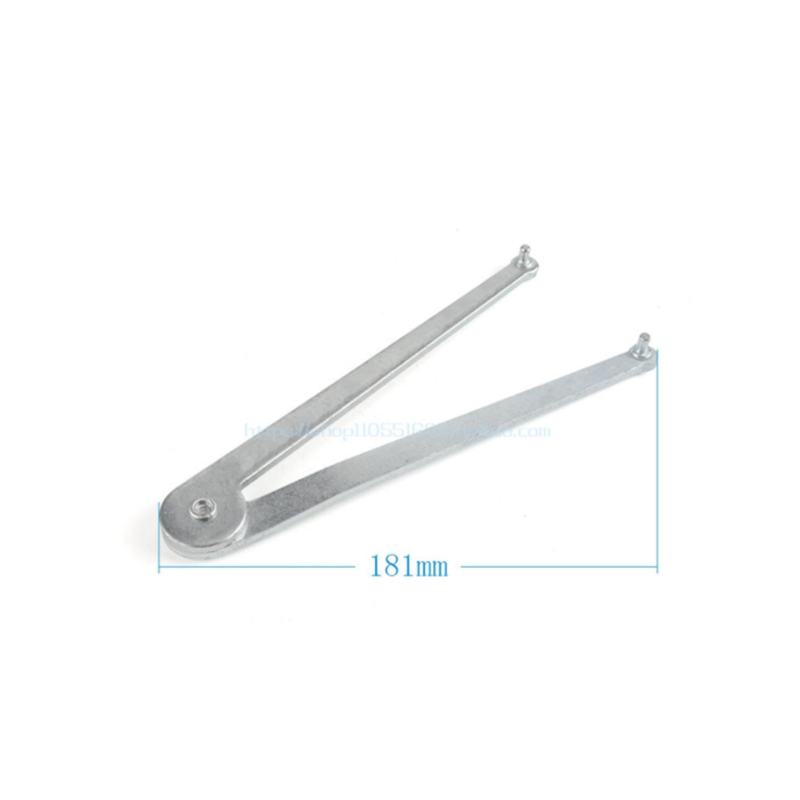
Multifunction angle mill wrench
Manufacturing Strengths of Lizhan Hardware Co., Ltd.
Lizhan Hardware Co., Ltd. operates from a China factory located at No. 2 Yuanrun Park, DaiFeng Road, Wanghai Town, Haiyan, Jiaxing City, Zhejiang, China. The company also identifies a Thailand warehouse at 18 M.1, T. Banbueng, A. Banbueng, Chonburi 20170, Thailand. This combination provides a useful foundation for serving customers that require manufacturing support in China together with regional warehousing in Thailand.
The company’s product information covers several hardware categories, including screws, self-drilling screws, drywall screws, roofing screws, furniture screws, stamping parts, eye hooks, fasteners, packages, and home tools. This broader hardware background is relevant to the multifunction angle mill wrench because it indicates experience with metal components, production coordination, fastener-related specifications, and international hardware supply.
A manufacturer that handles both stamped parts and fastener products can understand the importance of dimensional control, material consistency, surface treatment, packaging, and delivery scheduling. These factors are essential for a small tool even when the product appears mechanically simple.
Integrated production thinking
The company’s strength can be evaluated through its ability to coordinate product development, production, inspection, packaging, and shipment. Buyers do not purchase only a metal wrench; they purchase a repeatable supply program. This includes communication, specification confirmation, production planning, quality feedback, and delivery support.
For distributors, repeatability is particularly important. The first sample may look satisfactory, but long-term commercial value depends on whether later batches maintain the same dimensions, surface appearance, packaging method, and practical performance. A structured manufacturing process helps reduce variation between orders.
Experience with customized hardware
Hardware customers often need more than a standard catalog item. They may request a private label, a different surface finish, a modified package, a specific carton quantity, a special product code, or a revised working dimension. A manufacturer familiar with different hardware categories is more likely to understand the commercial and technical implications of these requests.
Customization should be managed through drawings, samples, approved specifications, and change records. This approach helps prevent misunderstandings between the buyer and factory. It also supports more predictable production when the item is reordered.
China manufacturing and Thailand warehousing support
The China factory location provides access to an established hardware manufacturing region with supporting suppliers, metal-processing resources, packaging services, and export logistics. The Thailand warehouse can be useful for regional inventory planning, especially for customers serving Southeast Asian markets or seeking shorter regional delivery routes.
Warehouse support does not eliminate the need for inventory planning. Buyers should confirm available stock, storage conditions, replenishment schedules, minimum order quantities, and shipping arrangements. Nevertheless, a regional warehouse can improve flexibility when properly coordinated with factory production and customer demand.
International communication
The company provides contact channels for sales and business communication, including WhatsApp, WeChat, email, and social media presence. Accessible communication can help buyers discuss drawings, samples, packaging, order quantities, and delivery requirements more efficiently.
For technical products, communication quality is part of product quality. A buyer should be able to clarify the intended angle mill model, required dimensions, material expectations, surface treatment, and packaging details before mass production begins. Clear communication reduces the risk of receiving an item that is visually similar but functionally unsuitable.
Quality Control Priorities for the Wrench
Quality control for a multifunction angle mill wrench should focus on the features that influence safety, fit, durability, and customer satisfaction. A visually attractive tool may still be unsuitable if its working points are misaligned or its material is too weak.
Dimensional accuracy
The overall length, width, thickness, opening, hole spacing, and working-point diameter should be controlled according to the approved specification. Dimensional variation can affect compatibility and operating ease.
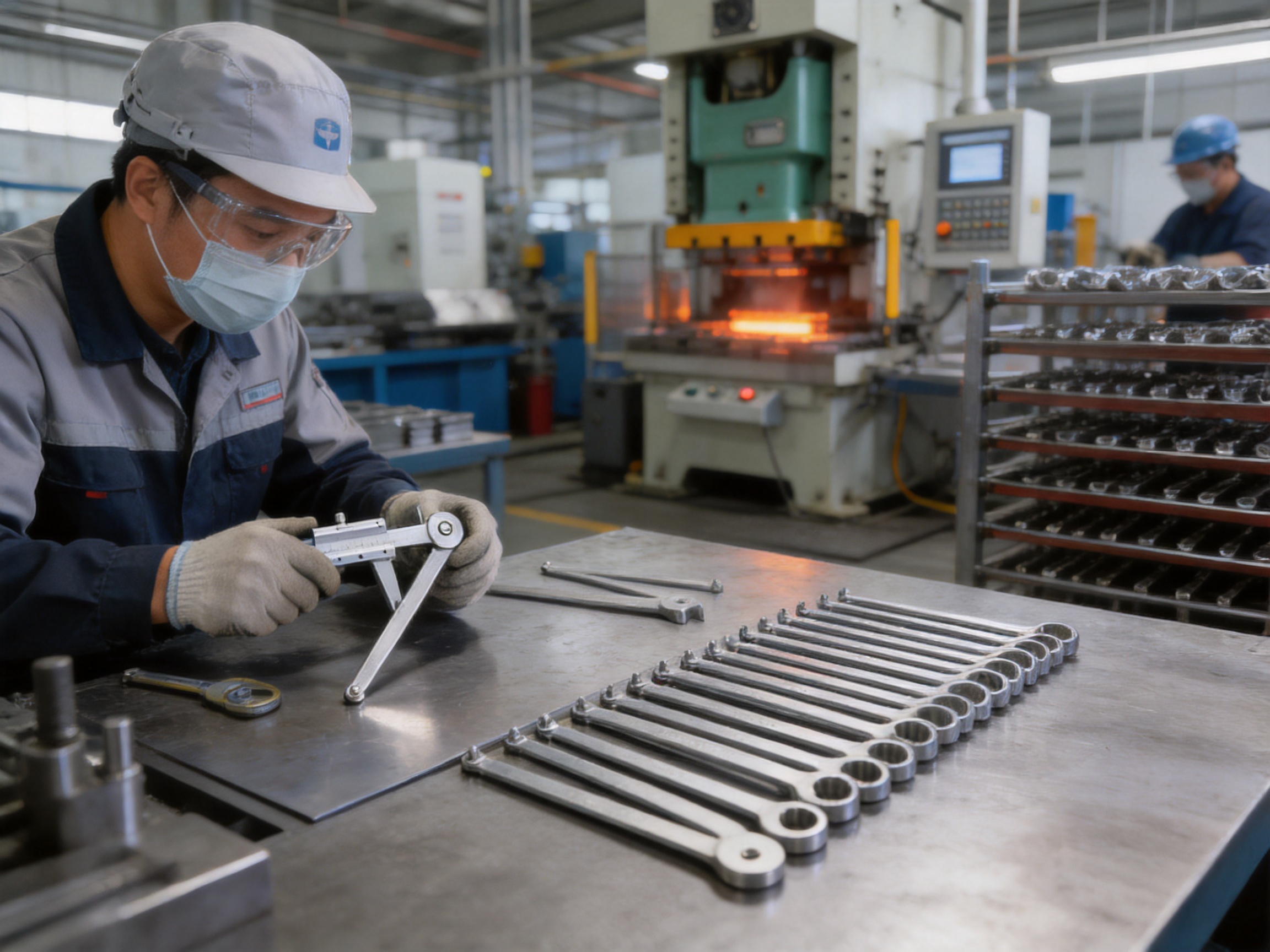
Inspection tools may include calipers, gauges, templates, profile instruments, and fixtures designed for the product. The selected measurement method should be repeatable and appropriate for the tolerance level.
Working-point alignment
For a wrench with pins or engagement points, alignment is essential. If two working points are not correctly positioned, the tool may engage unevenly or fail to contact the fastening component properly. A simple functional gauge can help verify alignment during production.
Strength and deformation resistance
Strength testing should reflect the intended use and agreed product standard. Testing may include torque loading, deformation observation, hardness measurement, or other appropriate methods. The purpose is to confirm that the tool can withstand normal service conditions without unacceptable bending, cracking, or loss of function.
Users should not extend the handle with a pipe or apply excessive force beyond the tool’s intended application. A properly manufactured wrench still has operating limits, and safe use requires following the equipment manufacturer’s maintenance guidance.
Burr and edge inspection
Uncontrolled burrs can affect handling, packaging, and fit. Each production lot should be checked for sharp unwanted edges, incomplete trimming, cracks, and forming marks that could interfere with use.
Coating and corrosion protection
Surface treatment should be inspected for uniformity and basic corrosion protection. Storage conditions also matter. Even a well-finished tool can develop corrosion if it is stored in a wet environment, exposed to chemicals, or packed while contaminated with moisture.
Packaging verification
Packaging should be checked for correct quantity, product identification, labeling, barcode information where required, and carton strength. Export orders also require attention to palletization, moisture protection, shipping marks, and documentation.
Advantages for Different Buyer Groups
For hardware wholesalers
Wholesalers can position the multifunction angle mill wrench as a practical accessory for professional and household tool channels. Its compact size supports efficient storage, while its broad application may make it suitable for several customer groups.
Wholesalers should request clear product specifications, compatible application information, packing quantities, and sample approval before placing a large order. These details help sales teams answer customer questions and reduce returns caused by incorrect expectations.
For retailers
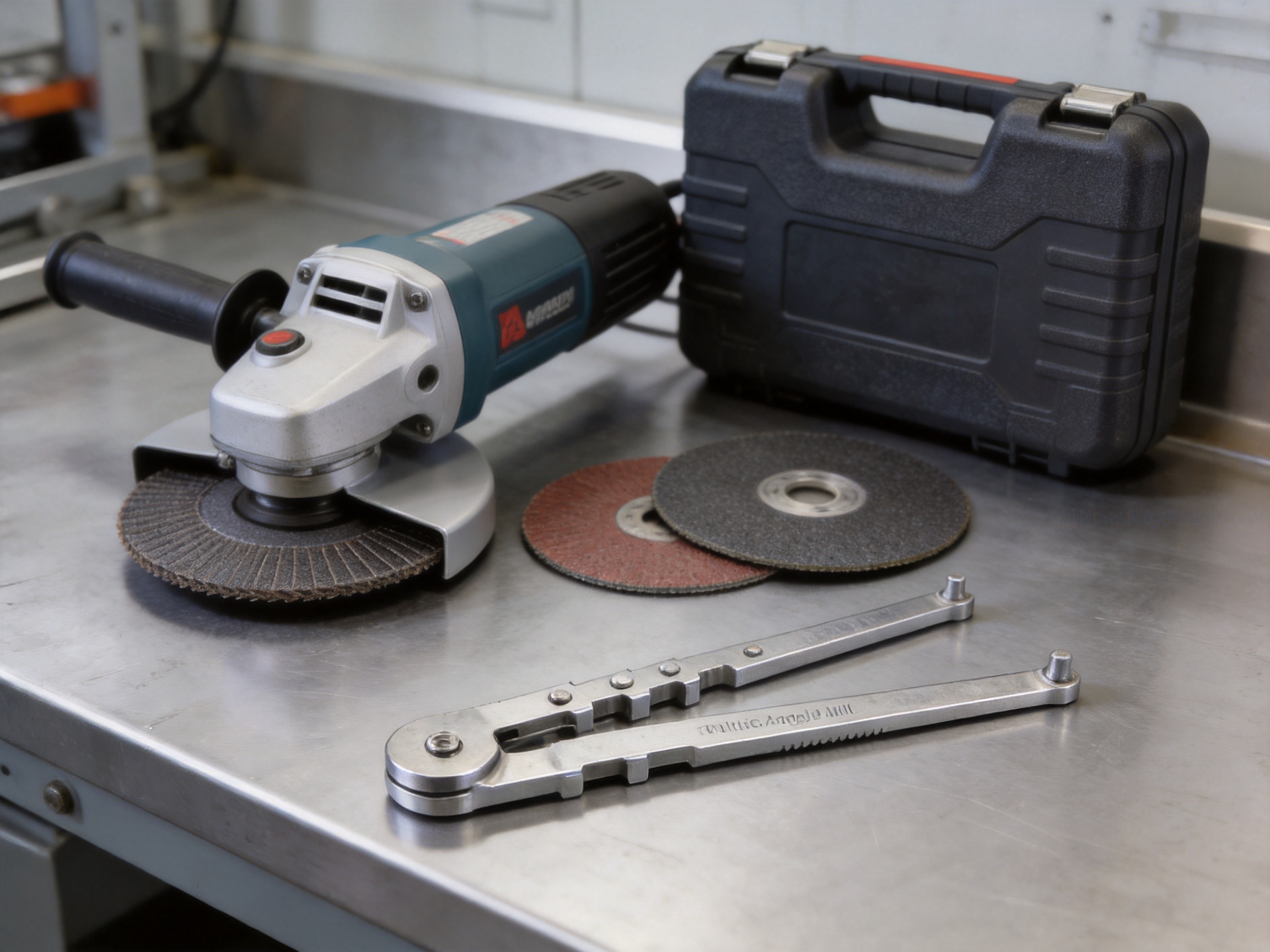
Retailers may display the wrench near angle grinders, abrasive discs, power-tool accessories, or general maintenance tools. Cross-merchandising can help customers recognize the product’s purpose. Retail packaging should communicate the application clearly without suggesting that the wrench is suitable for every machine or every fastening condition.
For tool brands
Tool brands may use the product as an accessory under their own packaging or as part of a maintenance kit. Private-label opportunities can include printed packaging, product labels, carton design, and bundled instructions. Brand owners should ensure that all claims on the packaging match the approved design and actual application range.
For equipment manufacturers
Equipment manufacturers can include the wrench with selected angle mills or grinder packages. Supplying the correct maintenance tool improves the completeness of the customer experience and may reduce questions about accessory replacement.
For professional users
Fabricators, contractors, maintenance workers, and repair technicians can benefit from keeping a dedicated wrench at each active workstation or in each service vehicle. A standardized accessory tool helps reduce time spent searching for a suitable alternative and supports more consistent maintenance routines.
For home users
Home workshop users often prefer tools that are simple, compact, and easy to store. The multifunction design can be attractive to people who use an angle grinder occasionally and do not want to purchase a large set of specialized tools. Instructions should still emphasize power disconnection, accessory compatibility, and safe handling.
Practical Operating Guidance
Before using the wrench, the angle mill or grinder should be switched off, unplugged, or otherwise isolated from its power source according to the equipment manufacturer’s procedure. Users should wait until all moving parts have stopped and should remove the battery where applicable.
The operator should confirm that the wrench’s working points match the fastening component. The tool should be positioned squarely and fully engaged before applying moderate hand force. If the fastening component is damaged, seized, contaminated, or outside the wrench’s intended range, the user should stop and select a suitable service method.
After an accessory change, the fastening component should be tightened according to the equipment manufacturer’s instructions. Excessive tightening can make future removal difficult or damage components. Insufficient tightening can create operating hazards. The wrench should not be used as a striking tool unless the product specification expressly permits that use.
After use, the wrench should be cleaned and stored in a dry location. Metal dust and abrasive residue can accumulate on tools used near grinding operations. Removing contamination helps preserve the surface finish and makes future inspection easier.
Procurement and Customization Process
A successful purchasing project should begin with an application review. Buyers should explain the intended equipment, expected order quantity, target market, preferred material, surface finish, packaging method, and any branding requirements. Photographs alone may not provide enough information for a reliable production decision.
Technical drawings are preferred when a modified product is required. A drawing should identify critical dimensions, tolerances, material, hardness or strength expectations, surface treatment, logo position, and packaging requirements. If a drawing is not available, a physical sample can be evaluated and converted into a production specification.
Sampling provides an opportunity to confirm fit, appearance, handling comfort, and packaging. Buyers should test the sample with the intended angle mill or compatible fastening component rather than evaluating it only by visual comparison.
Once the sample is approved, the final specification should be recorded. Any later design change should be reviewed and approved before mass production. This is especially important when a change affects material thickness, working-point location, coating, packaging, or compatibility.
Order planning should also consider production lead time, raw material availability, tooling requirements, inspection timing, carton quantities, and shipping method. For customers using the Thailand warehouse, stock transfer and regional delivery arrangements should be discussed separately from China factory production.
Why Manufacturing Consistency Is a Competitive Advantage
Many low-cost tools may appear similar at first glance. Competitive advantage is therefore created through the details that buyers experience over time. Consistent dimensions, stable material quality, controlled surface treatment, reliable packaging, and responsive communication can distinguish a professional supplier from an unreliable source.
A manufacturer with broader hardware experience can apply lessons from screws, stamping parts, hooks, and other metal products to the production of a compact wrench. Tooling maintenance, batch control, surface protection, packing discipline, and export coordination are all transferable manufacturing capabilities.
Lizhan Hardware Co., Ltd. can present the multifunction angle mill wrench within a wider hardware supply capability rather than as an isolated item. This may be valuable for customers who want to consolidate orders, coordinate multiple hardware categories, or work with one supplier for both standard and customized products.
The China factory and Thailand warehouse structure may also support different purchasing strategies. A buyer can discuss factory-direct production for planned orders while considering regional inventory for urgent or recurring demand. The most suitable model depends on volume, market location, storage costs, forecast accuracy, and delivery expectations.
Maintenance, Storage, and Service Life
The service life of the wrench depends on material, production quality, frequency of use, applied force, storage conditions, and exposure to chemicals or moisture. Proper use can help preserve the working geometry and surface finish.
Users should inspect the wrench periodically for bending, cracks, damaged pins, excessive wear, or corrosion. A tool that has been deformed or visibly damaged should not continue in service. Replacing a small maintenance wrench is preferable to relying on a tool whose engagement is no longer dependable.
Storage should keep the wrench away from standing water, corrosive chemicals, and abrasive contamination. In humid climates, light protective oil or suitable corrosion protection may be considered if compatible with the product finish and application.
For distributors, service-life information should be communicated carefully. No hand tool lasts indefinitely under misuse or excessive loading. Product descriptions should explain the intended application and should not encourage unsafe modifications such as extending the handle or striking the wrench with another object.
Responsible Product Communication
Clear product communication supports both safety and commercial success. Product listings should state the product name, category, primary application, material information when confirmed, finish, size range, packaging, and compatibility guidance.
Claims such as “universal,” “indestructible,” or “fits all machines” should be avoided unless they can be technically demonstrated and supported by the approved specification. A more accurate description is that the multifunction angle mill wrench is designed for multiple related angle mill or grinder maintenance applications within its defined working range.
Retailers and distributors should also distinguish between the wrench and the powered equipment. The wrench is a manual maintenance accessory. It does not replace machine guards, personal protective equipment, lockout procedures, or the safety instructions supplied with the angle mill or grinder.
Environmental and Operational Considerations
Metal tools have the advantage of being durable, compact, and potentially recyclable at the end of their useful life. Extending service life through suitable material selection, accurate manufacturing, protective finishing, and responsible storage can reduce unnecessary replacement.
Packaging should be designed to protect the product without creating excessive waste. Buyers may discuss recyclable cartons, reduced plastic use, bulk packing, or reusable storage options. The most appropriate packaging depends on retail presentation, export requirements, product protection, and customer expectations.
Efficient logistics can also reduce operational waste. Coordinating factory production with warehouse inventory, consolidating shipments, and forecasting demand can help prevent urgent small shipments and unnecessary handling. The China factory and Thailand warehouse can be evaluated as part of a broader supply-chain plan.
Recommended Buyer Checklist
Before ordering the multifunction angle mill wrench, buyers should confirm the following points:
1. The intended application and compatible angle mill or grinder fastening arrangement.
2. Overall dimensions, working-point dimensions, thickness, and tolerance requirements.
3. Material grade or minimum performance expectation.
4. Heat-treatment requirement, if applicable.
5. Surface finish and corrosion-protection expectation.
6. Sample approval procedure and functional testing method.
7. Product marking, logo, label, and private-packaging requirements.
8. Quantity per inner package and export carton.
9. Production lead time, minimum order quantity, and replenishment plan.
10. China factory shipment options and Thailand warehouse availability.
11. Inspection responsibility and acceptable quality limits.
12. Documentation, shipping marks, and after-sales communication process.
This checklist allows buyers to compare suppliers on meaningful factors rather than relying only on unit price. It also helps the manufacturer understand the customer’s priorities before tooling, sampling, and mass production begin.
Q&A: Multifunction Angle Mill Wrench
What is a multifunction angle mill wrench used for?
It is used for routine adjustment and removal of compatible fastening components on angle mills and angle grinders, especially during grinding-disc, cutting-wheel, polishing-accessory, or maintenance changes. The exact application range depends on the product dimensions and equipment design.
Why choose a dedicated wrench instead of pliers?
A dedicated wrench is designed to engage the intended fastening points more appropriately. Pliers may slip, mark surfaces, or damage components. A purpose-made wrench can make ordinary maintenance more controlled and convenient.
Does multifunction mean that the wrench fits every angle grinder?
No. Multifunction indicates that the product is designed for multiple related applications, but it still has dimensional limits. Buyers should confirm the working-point size and compatibility before ordering or using the wrench.
Can the wrench be used on seized or damaged nuts?
It should be used only within its intended application and normal operating limits. A seized or damaged fastening component may require a specialized service procedure. Excessive force, handle extensions, or striking should not be used unless expressly approved by the relevant product specification.
What materials may be used to manufacture the wrench?
Suitable steel or another specified metal may be used depending on the required strength, thickness, forming method, and customer requirements. The exact material should be confirmed with the manufacturer for each production specification.
Can the product be customized?
Customization may include dimensions, surface finish, product marking, private-label packaging, carton quantity, and other commercial details. A technical drawing or approved sample is recommended for customized production.
How should buyers test a sample?
The sample should be tested with the intended angle mill or compatible fastening component. Buyers should check engagement, alignment, operating comfort, visible defects, surface finish, and basic resistance to normal hand force.
What manufacturing processes are important for this product?
Important processes may include material preparation, blanking, stamping, forming, deburring, heat treatment where required, surface finishing, dimensional inspection, functional verification, and protective packaging.
What quality points should distributors inspect?
Distributors should inspect dimensions, working-point alignment, burrs, cracks, bending, finish consistency, corrosion, packaging quantity, labeling, and compatibility information. Inspection criteria should be agreed before production.
Why is a Thailand warehouse useful?
A Thailand warehouse may support regional inventory and delivery for customers in Thailand and nearby Southeast Asian markets. Buyers should confirm current stock, replenishment timing, storage arrangements, and delivery terms directly with the supplier.
Can the wrench be supplied with other hardware products?
It may be suitable for combined orders involving fasteners, stamping parts, eye hooks, screws, and other hardware products, subject to the supplier’s production and packaging capabilities. Consolidated sourcing can simplify communication and shipment planning.
What information should be included in a product listing?
A listing should include the product name, intended application, compatibility range, dimensions, material when confirmed, surface finish, packaging, customization options, and safe-use guidance. Unsupported universal or unlimited-performance claims should be avoided.
How should the wrench be stored?
It should be stored in a dry, clean place away from standing water, corrosive chemicals, and excessive abrasive dust. Periodic inspection can identify corrosion, deformation, or wear before the tool is needed.
Who can purchase this type of product?
Potential buyers include hardware wholesalers, tool retailers, equipment manufacturers, maintenance companies, importers, private-label brands, construction suppliers, and professional workshops.
How can a buyer communicate with the supplier?
Lizhan Hardware Co., Ltd. provides email, telephone, WhatsApp, and WeChat contact options. Buyers can use these channels to discuss product specifications, samples, packaging, order quantities, and shipment arrangements.
Conclusion
The multifunction angle mill wrench is a compact but useful tool for routine angle mill and angle grinder maintenance. Its primary advantages include multi-application convenience, portability, purpose-designed engagement, efficient accessory changes, flexible packaging, and suitability for professional, retail, and home workshop channels.
Its competitiveness depends on the complete manufacturing system behind it. Material control, accurate stamping or forming, suitable heat treatment, careful deburring, consistent surface finishing, functional inspection, and protective packaging all contribute to dependable product performance. Buyers should evaluate these elements together instead of comparing price alone.
Lizhan Hardware Co., Ltd. brings the product into a broader hardware manufacturing and supply environment that includes screws, fasteners, stamping parts, eye hooks, packages, and home tools. Its China factory provides a production base, while its Thailand warehouse may support regional distribution. This structure can be useful for customers seeking standard products, customized hardware, consolidated sourcing, or Southeast Asian delivery support.
For the best commercial result, buyers should confirm compatibility, dimensions, material, finish, packaging, inspection requirements, and logistics before placing an order. With clear specifications and controlled production, the multifunction angle mill wrench can become a practical addition to tool kits, maintenance packages, retail hardware ranges, and professional workshop inventories.
References
1. General principles of hand-tool design, including dimensional accuracy, ergonomic handling, working-point engagement, and mechanical durability.
2. Standard manufacturing practices for stamped metal components, including blanking, forming, deburring, tooling maintenance, and batch inspection.
3. Industrial guidance concerning angle grinder accessory replacement, equipment isolation, protective guards, and safe maintenance procedures.
4. Quality-control principles for metal hardware products, including material identification, dimensional inspection, surface-finish review, and packaging verification.
5. Export hardware supply practices covering sample approval, private-label packaging, warehouse coordination, carton protection, and international shipment planning.
6. Product and company information supplied for the multifunction angle mill wrench and Lizhan Hardware Co., Ltd.